# Myofunctional Therapists Get Reflex Integration Tools
Nearly every human skill and functional activity depends on the foundations laid down in infancy via the neurodevelopmental movements. For example, sucking and rooting are infant primitive reflex movements directly related to the function of the mouth. Another lesser-known example is the set of infant rhythmic movements which help to develop the brainstem. A well-developed brainstem controls muscle tone, which then helps with the overall function of the muscles—including muscles of the mouth and tongue. The rhythmic movements also provide stimulation to mature the cerebellum, which among other things, is involved in coordinating mouth movements.Marge Foran is an expert dental hygienist and myofunctional therapist, who recognizes the connection between neurodevelopmental movements and myofunctional therapy:
> "It is important to understand how retained primitive reflexes can impact the fine motor skills required for the functions of the orofacial muscles. I highly recommend the [Brain and Sensory Foundations courses](https://moveplaythrive.com/index.php?Itemid=362 "Training in rhythmic movements and primitive reflex integration") for those providing orofacial myofunctional therapy."
> Marge Foran, BA, RDH, COM
### Connections between neurodevelopmental movements and mouth and tongue function
Have you ever seen children (or adults) move their mouth or tongue while doing fine-motor tasks such as writing or using scissors? These overflow movements of the hands (and sometimes the feet) are connected to mouth movements in infancy. This tendency is supposed to go away after the toddler stage, but if it lingers, it is a sign of neuro-sensory-motor immaturity. Another sign of immaturity is excessive drooling, which is often helped by integration of the hand reflexes! [Here is one example](https://moveplaythrive.com/index.php?option=com_content&view=article&id=235:boy-stops-drooling-begins-speaking-enjoys-playing-with-peers&catid=65:case-studies&Itemid=153 "Boy stops drooling, begins speaking"). [And here is another example.](https://moveplaythrive.com/index.php?option=com_content&view=article&id=114:boy-with-dev-delay-eats-more-explores-and-plays-with-brother-flourishes&catid=65:case-studies&Itemid=153 "Boy with dev delay makes great gains, less drooling")
#### Check out the case studies here and see how innate rhythmic movements and reflex integration can help to greatly reduce or eliminate compulsive chewing, mouthing, and oral sensory seeking.
[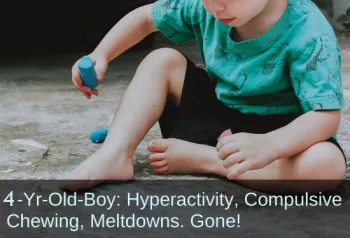](https://moveplaythrive.com/index.php?option=com_content&view=article&id=170:4-yr-old-boy-hyperactivity-compulsive-chewing-meltdowns-gone&catid=65:case-studies&Itemid=503 "Help for compulsive chewing")
In addition to impulsivity, meltdowns, and difficulties following directions, this 4-year-old compulsively chewed blinds, curtains, and toys. [Rhythmic movements and primitive reflex integration made a huge difference for him and he now rarely chews non-food items.](https://moveplaythrive.com/index.php?option=com_content&view=article&id=170:4-yr-old-boy-hyperactivity-compulsive-chewing-meltdowns-gone&catid=65:case-studies&Itemid=503 "Help for compulsive chewing")
[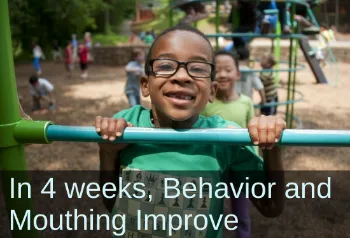](https://moveplaythrive.com/index.php?option=com_content&view=article&id=141:6-year-old-boy-no-more-hitting-biting-and-constant-moving&catid=65:case-studies&Itemid=503 "Help for chewing and mouthing")
This little boy often chewed his clothing, and had extreme difficulty sitting still. After four weeks of rhythmic movements and primitive reflex integration, he [no longer moves constantly, and there is far less throwing, hitting, and mouthing.](https://moveplaythrive.com/index.php?option=com_content&view=article&id=141:6-year-old-boy-no-more-hitting-biting-and-constant-moving&catid=65:case-studies&Itemid=503 "Help for mouthing and chewing")
[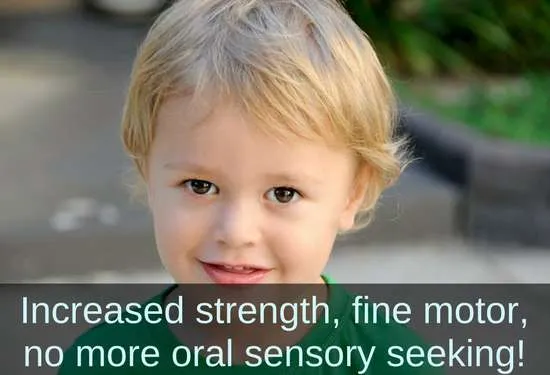](https://moveplaythrive.com/index.php?option=com_content&view=article&id=225:ot-stunned-by-4-year-olds-progress&catid=65:case-studies&Itemid=503 "Help for sensory seeking and thumb sucking")
This preschooler sucked his thumb, had poor posture, weak gross and fine motor skills, and severe oral sensory seeking—putting many non-food items in his mouth. After two months of rhythmic movements and primitive reflex integration, [he stunned his therapist with his enormous progress in all areas of concern.](https://moveplaythrive.com/index.php?option=com_content&view=article&id=225:ot-stunned-by-4-year-olds-progress&catid=65:case-studies&Itemid=503 "Help for sensory seeking and thumb sucking")
[Find Out More](https://moveplaythrive.com/index.php?Itemid=362)
[Enroll Now](https://moveplaythrive.com/index.php?Itemid=362#enroll "Comprehensive rhythmic movement and primitive reflex Integration course")
## 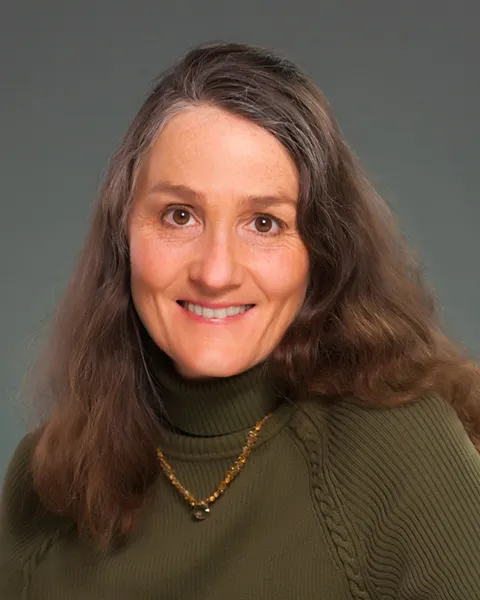
Sonia Story, M.S. has been teaching neurodevelopmental movements since 2006.
Sonia developed the Brain and Sensory Foundations program to provide comprehensive training in neurodevelopmental movements—combining innate rhythmic movements, play, primitive reflexes, and postural reflexes.
She earned a Bachelor's degree in biology/psychology and a Master’s degree in Movement Sciences. She is the author of [The Importance of Reflex Integration](https://moveplaythrive.com/index.php?Itemid=513) and the [Evidence eBook](https://moveplaythrive.com/index.php?Itemid=536 "Free 47 page Evidence eBook"), giving the rationale and evidence basis for using neurodevelopmental movements for helping with challenges such as ADHD, Sensory Processing Disorders, anxiety, emotional dysregulation, visual skill deficits, poor social skills, gross and fine motor delays and other neurodevelopmental and behavioral disorders.
Her work is featured in numerous podcasts, summits, and conferences, and in the books *Almost Autism: Recovering Children from Sensory Processing Disorder; Special Ed Mom Survival Guide; Family Health Revolution; and Same Journey, Different Paths—Stories of Auditory Processing Disorder.*
Sonia’s mission is to help children and families experience the profound benefits of neurodevelopmental and integrative movements for more functional and fulfilling lives.
[Read about Sonia's personal journey with reflex integration](https://moveplaythrive.com/#meet-sonia)
[Get more information about Sonia's education and CV](https://moveplaythrive.com/index.php?Itemid=517 "About Sonia Story-Education and CV")