# Amphibian Reflex
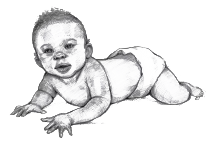The Amphibian reflex is an important postural reflex that helps us to voluntarily move in a rhythmic and coordinated manner. As with other postural reflexes, once it emerges—in this case between the ages of 4 and 6 months—the Amphibian ideally remains active throughout the lifespan. When this reflex is absent or underdeveloped, fatigue, clumsiness, or difficulty engaging in cross-pattern movements may result.
A well-developed Amphibian reflex is a marker of central nervous system maturity, as indicated by the infant’s ability to isolate and move one leg without automatic (i.e. reflexive) movements of the other limbs or the head. This independent limb movement is essential to the proper development of belly crawling, hands-and-knees crawling, walking, and running.
Coordinated, volitional crawling is vital for brain maturation, posture, and formal learning. Infants who crawl demonstrate more flexible memory retrieval than those that have not yet learned to crawl. While there are children who skipped belly crawling that do not develop learning challenges, of the children who *do* have learning issues, the percentage of them that missed the belly crawling stage is higher than in children without learning difficulties.
When the Amphibian reflex is unintegrated, it is often associated with [symptoms of ADHD and ADD](https://moveplaythrive.com/index.php?option=com_content&view=article&id=254&catid=71&Itemid=633 "Learn about overcoming ADD and ADHD symptoms through reflex integration"). According to Harald Blomberg, MD, ADD/ADHD symptoms are partly due to poor establishment of the neural pathways connecting the cerebellum, prefrontal cortex, and vestibular system. By integrating primitive reflexes and developing postural reflexes—such as the Amphibian—it is possible to improve these neural pathways and lay the foundation for mature brain function.
### Possible Long-Term Effects of an Underdeveloped Amphibian Reflex include:
- Learning challenges
- Inability to maintain focus
- Easily frustrated
- Fatigue
- Stiff, awkward movement
- Leg tension or clumsiness
- Cross-pattern movements may be challenging, tiring, or asymmetrical
- Difficulty integrating the Asymmetrical Tonic Neck and Spinal Galant reflexes
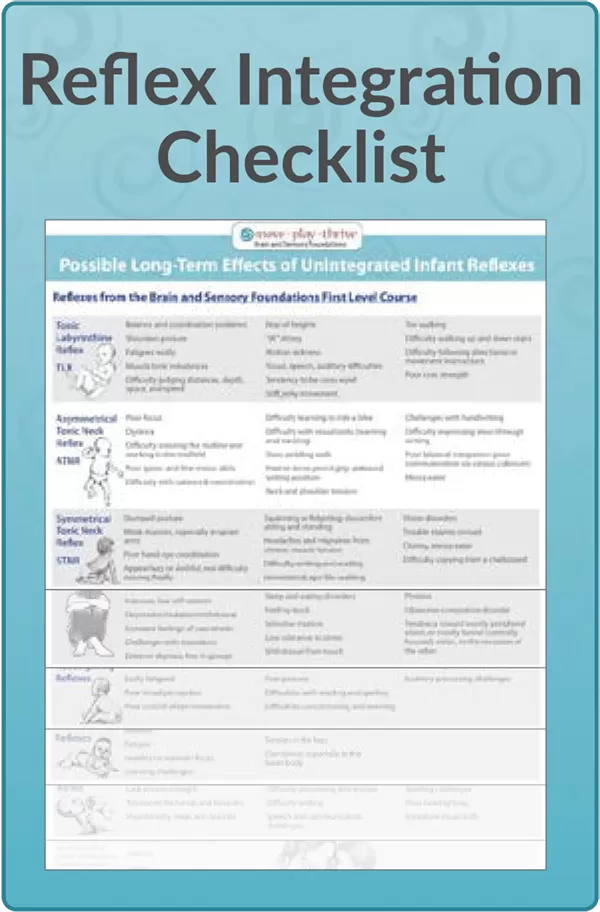
### Get Your Comprehensive Chart with a Checklist for Each Primitive and Postural Reflex
[](https://moveplaythrive.com/index.php?Itemid=538 "Possible long-term effects for individual primitive and postural reflexes")
- [Amphibian Reflex](https://moveplaythrive.com/resources/primitive-and-postural-reflexes/amphibian-reflex)
- [Asymmetrical Tonic Neck Reflex](https://moveplaythrive.com/resources/primitive-and-postural-reflexes/asymmetrical-tonic-neck-reflex)
- [Birth and Bonding](https://moveplaythrive.com/resources/primitive-and-postural-reflexes/birth-and-bonding)
- [Crawling Reflexes](https://moveplaythrive.com/resources/primitive-and-postural-reflexes/crawling-reflexes)
- [Crossed Extensor Reflex](https://moveplaythrive.com/resources/primitive-and-postural-reflexes/crossed-extensor-reflex)
- [Facial-Oral Reflexes](https://moveplaythrive.com/resources/primitive-and-postural-reflexes/facial-oral-reflexes)
- [Fear Paralysis Reflex ](https://moveplaythrive.com/resources/primitive-and-postural-reflexes/fear-paralysis-reflex)
- [Feet Reflexes—Plantar & Babkinski](https://moveplaythrive.com/resources/primitive-and-postural-reflexes/feet-reflexes-plantar-babkinski)
- [Foot Tendon Guard ](https://moveplaythrive.com/resources/primitive-and-postural-reflexes/foot-tendon-guard)
- [Hand Reflexes—Grasp, Palmar, and Babkin](https://moveplaythrive.com/resources/primitive-and-postural-reflexes/hand-reflexes-grasp-palmar-and-babkin)
- [Headrighting Reflexes](https://moveplaythrive.com/resources/primitive-and-postural-reflexes/headrighting-reflexes)
- [Infant Torticollis](https://moveplaythrive.com/resources/primitive-and-postural-reflexes/infant-torticollis)
- [Landau Reflex](https://moveplaythrive.com/resources/primitive-and-postural-reflexes/landau-reflex)
- [Moro Reflex](https://moveplaythrive.com/resources/primitive-and-postural-reflexes/moro-reflex)
- [Parachute Reflex](https://moveplaythrive.com/resources/primitive-and-postural-reflexes/parachute-reflex)
- [Pull-to-Sit Reflex](https://moveplaythrive.com/resources/primitive-and-postural-reflexes/pull-to-sit-reflex)
- [Spinal Galant Reflex](https://moveplaythrive.com/resources/primitive-and-postural-reflexes/spinal-galant-reflex)
- [Spinal Perez Reflex](https://moveplaythrive.com/resources/primitive-and-postural-reflexes/spinal-perez-reflex)
- [Symmetrical Tonic Neck Reflex](https://moveplaythrive.com/resources/primitive-and-postural-reflexes/symmetrical-tonic-neck-reflex)
- [Tonic Labyrinthine Reflex](https://moveplaythrive.com/resources/primitive-and-postural-reflexes/tonic-labyrinthine-reflex)
[Find Out More](https://moveplaythrive.com/index.php?Itemid=362)
[Enroll Now](https://moveplaythrive.com/index.php?Itemid=362#enroll "Comprehensive rhythmic movement and primitive reflex Integration course")
**Sources**
Blomberg, H. (2015). *The rhythmic movement method: A revolutionary approach to improved health and well-being*. Lulu.com.
Goddard Blythe, S. (2023). *Reflexes, movement, learning & behavior. Analysing and unblocking neuro-motor immaturity*. Hawthorn Press.
Goddard Blythe, S. (2009). *Attention, balance, and coordination: The A.B.C. of learning success*. Wiley-Blackwell, a John Wiley & Sons, Publication.
Masgutova, S. (2007). *Integration of infant dynamic and postural reflex patterns: Neuro-sensory-motor and reflex integration method* \[Training manual\].