# Foot Tendon Guard
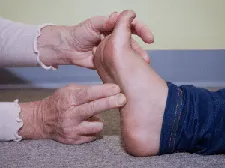The Foot Tendon Guard Response is a protective response activated by physical or emotional stress. It represents a set of physiological changes rather than a distinctive movement pattern, and therefore is not a true primitive or postural reflex—though it supports the integration of several primitive reflexes.
In this response, when the body goes into a fight or flight reaction the muscles and tendons of the feet contract. Tightening can also occur in the backs of the legs, sacrum, spine, and/or occiput.
In infants from birth to approximately one year of age, stroking from the ball of the foot down the medial side of the arch typically produces flexion and withdrawal of both feet and legs. Later the same stimulus should result in flexion only on the side of the body being touched. While Foot Tendon Guard ideally integrates over time, it is still meant to be available across the lifespan when there is a highly stressful event. However, if the Foot Tendon Guard Response is over-engaged, i.e. chronically active, it can contribute to immense physical tension—particularly tight calf muscles—emotional frailty, poor flexibility, and in some cases deformities of the feet, knees, hips, or spine.
Because it is triggered by stress, to reduce the expression of Foot Tendon Guard it is important to support the nervous system by integrating other primitive reflexes as well, especially [Moro](https://moveplaythrive.com/index.php?option=com_content&view=article&id=470&catid=101&Itemid=913 "Moro, Infant Startle Reflex") and [Fear Paralysis](https://moveplaythrive.com/index.php?option=com_content&view=article&id=469&catid=101&Itemid=913 "Fear Paralysis Reflex information"). These reflexes are associated with fight or flight, and freeze, respectively.
### Possible Long-Term Effects of an Over-Active Foot Tendon Guard Response Include:
- Foot and/or leg cramps
- Inability to fully integrate the Babinski Reflex or the Plantar Reflex
- Tension in the feet, legs, back of the body
- Poor balance
- Improper alignment and posture
- Poor gross motor coordination
- Difficulty walking and running
- Speech challenges, including selective mutism
- Rigid thinking
- Fearful, easily stressed
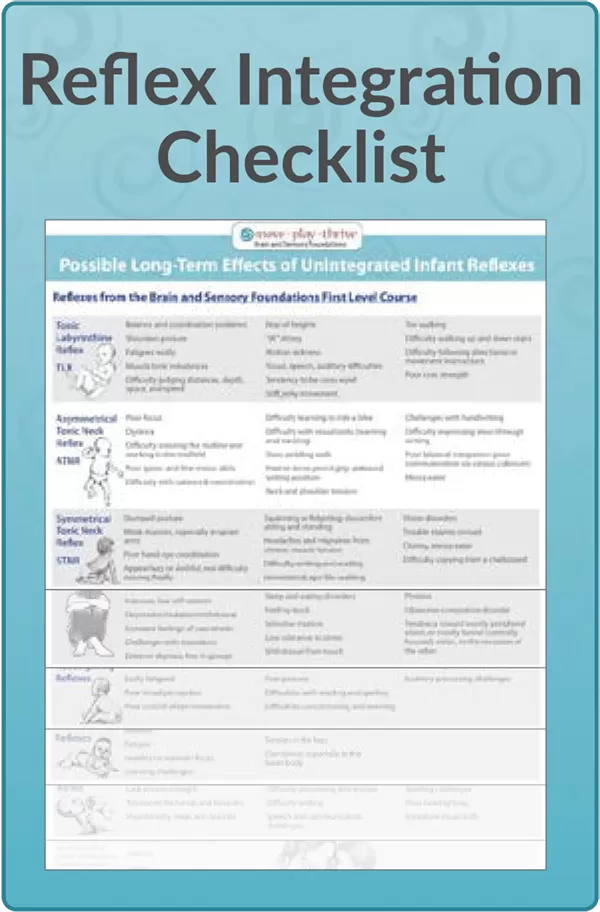
### Get Your Comprehensive Chart with a Checklist for Each Primitive and Postural Reflex
[](https://moveplaythrive.com/index.php?Itemid=538 "Get your Free Reflexes Checklist Chart")
- [Amphibian Reflex](https://moveplaythrive.com/resources/primitive-and-postural-reflexes/amphibian-reflex)
- [Asymmetrical Tonic Neck Reflex](https://moveplaythrive.com/resources/primitive-and-postural-reflexes/asymmetrical-tonic-neck-reflex)
- [Birth and Bonding](https://moveplaythrive.com/resources/primitive-and-postural-reflexes/birth-and-bonding)
- [Crawling Reflexes](https://moveplaythrive.com/resources/primitive-and-postural-reflexes/crawling-reflexes)
- [Crossed Extensor Reflex](https://moveplaythrive.com/resources/primitive-and-postural-reflexes/crossed-extensor-reflex)
- [Facial-Oral Reflexes](https://moveplaythrive.com/resources/primitive-and-postural-reflexes/facial-oral-reflexes)
- [Fear Paralysis Reflex ](https://moveplaythrive.com/resources/primitive-and-postural-reflexes/fear-paralysis-reflex)
- [Feet Reflexes—Plantar & Babkinski](https://moveplaythrive.com/resources/primitive-and-postural-reflexes/feet-reflexes-plantar-babkinski)
- [Foot Tendon Guard ](https://moveplaythrive.com/resources/primitive-and-postural-reflexes/foot-tendon-guard)
- [Hand Reflexes—Grasp, Palmar, and Babkin](https://moveplaythrive.com/resources/primitive-and-postural-reflexes/hand-reflexes-grasp-palmar-and-babkin)
- [Headrighting Reflexes](https://moveplaythrive.com/resources/primitive-and-postural-reflexes/headrighting-reflexes)
- [Infant Torticollis](https://moveplaythrive.com/resources/primitive-and-postural-reflexes/infant-torticollis)
- [Landau Reflex](https://moveplaythrive.com/resources/primitive-and-postural-reflexes/landau-reflex)
- [Moro Reflex](https://moveplaythrive.com/resources/primitive-and-postural-reflexes/moro-reflex)
- [Parachute Reflex](https://moveplaythrive.com/resources/primitive-and-postural-reflexes/parachute-reflex)
- [Pull-to-Sit Reflex](https://moveplaythrive.com/resources/primitive-and-postural-reflexes/pull-to-sit-reflex)
- [Spinal Galant Reflex](https://moveplaythrive.com/resources/primitive-and-postural-reflexes/spinal-galant-reflex)
- [Spinal Perez Reflex](https://moveplaythrive.com/resources/primitive-and-postural-reflexes/spinal-perez-reflex)
- [Symmetrical Tonic Neck Reflex](https://moveplaythrive.com/resources/primitive-and-postural-reflexes/symmetrical-tonic-neck-reflex)
- [Tonic Labyrinthine Reflex](https://moveplaythrive.com/resources/primitive-and-postural-reflexes/tonic-labyrinthine-reflex)
[Find Out More](https://moveplaythrive.com/index.php?Itemid=362)
[Enroll Now](https://moveplaythrive.com/index.php?Itemid=362#enroll "Comprehensive rhythmic movement and primitive reflex Integration course")
**Sources**
Masgutova, S. (2007). *Integration of infant dynamic and postural reflex patterns: Neuro-sensory-motor and reflex integration method* \[Training manual\].
Rentschler, M. (2009). The tendon guard reflex. *Developmental Delay Resources, 12*(4), 6. Retrieved from newsletter/articles/pdf/379-the-tendon-guard-reflex.pdf