---
title: "Move Play Thrive | Brain and Sensory Foundations Course - Spinal Galant Reflex"
description: "The Spinal Galant reflex synchronizes simultaneous movement of the upper and lower body to assist with creeping and crawling, and is related to bladder function. An unintegrated Spinal Galant is associated with bedwetting, hypersensitivity, fidgeting, scoliosis, attention deficits, and back pain."
url: "https://moveplaythrive.com/resources/primitive-and-postural-reflexes/spinal-galant-reflex"
date: "2026-07-06T05:53:17+00:00"
language: "en-US"
---
# Spinal Galant Reflex
The Spinal Galant Reflex involves hip rotation when the back is touched on either side of the spine. The stimulation causes the infant’s pelvis to tilt up towards the head on the side of the body being touched. The shoulder and head may also curl down towards the hip. This reflex is important for addressing bedwetting, back pain or tension, tactile sensitivity, and fidgeting.
Spinal Galant emerges in the womb and is ideally integrated 3 to 9 months after birth. The asymmetrical pelvic tilt and shoulder-drop movement that occurs when this reflex is activated likely assists in the birthing process, working in conjunction with the [Asymmetrical Tonic Neck Reflex](https://moveplaythrive.com/index.php?option=com_content&view=article&id=467&catid=101&Itemid=913 "Get info on the importance of ATNR") to help the infant make the required turns down the birth canal during a natural birth. Spinal Galant is often unintegrated in children born via Cesarean-section, likely due to the lack of tactile stimulation that would normally be provided in a natural birth.
After birth, the Spinal Galant helps to synchronize simultaneous upper and lower body movements on one side, assisting in coordinating the body for belly crawling and creeping.
When this reflex is unintegrated, individuals are often hypersensitive to clothing and other tactile stimulation on the back—such as leaning against the back of a chair. This reflex also appears to be connected to bladder function: in children who continue [bedwetting](https://moveplaythrive.com/index.php?option=com_content&view=article&id=279&catid=89&Itemid=636 "See how reflex integration can help with bedwetting challenges") past the age of five years, a retained Spinal Galant reflex is often present (Goddard Blythe, 2023). When the Spinal Galant reflex is retained on only one side of the back, it is associated with [scoliosis](https://moveplaythrive.com/index.php?option=com_content&view=article&id=286&catid=102&Itemid=648 "Learn how reflex integration can help with scoliosis") (Sharma & Saxena, 2024; Ferrari et al., 2010), and with abnormal gait and locomotion (Goddard Blythe, 2023). As Goddard Blythe explains, when unintegrated the Spinal Galant reflex can be quite uncomfortable because it can interfere with postural control—which is the basis for the skill of attention—and because it may feel like “a constant irritant” that vies for attention. Other signs that a retained Spinal Galant reflex may be an issue are: fidgeting, poor concentration, and deficits in short-term memory (Goddard Blythe, 2023).
### Possible Long-Term Effects of an Unintegrated Spinal Galant:
- Hypersensitivity, especially on the back
- Bedwetting
- Fatigue
- Attention difficulties
- Hip rotation to one side
- Poor concentration
- Poor coordination
- Poor posture
- Poor short-term memory
- Fidgeting/hyperactivity
- Difficulty sitting still
- Irritable bowel syndrome (as an adult)
- Back pain
- Scoliosis
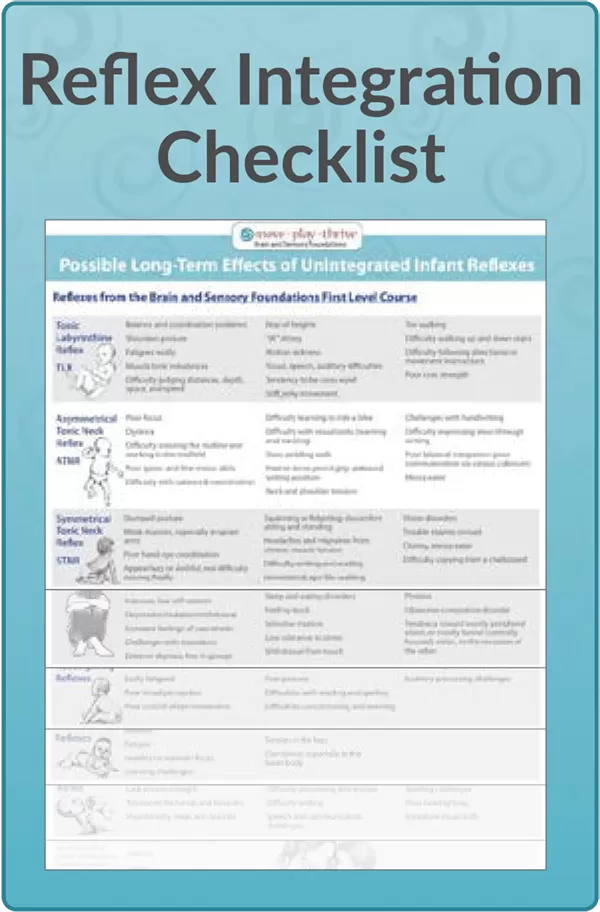
### Get Your Comprehensive Chart with a Checklist for Each Primitive and Postural Reflex
[](https://moveplaythrive.com/index.php?Itemid=538 "Get the lists of possible long-term effects for retained reflexes")
- [Amphibian Reflex](https://moveplaythrive.com/resources/primitive-and-postural-reflexes/amphibian-reflex)
- [Asymmetrical Tonic Neck Reflex](https://moveplaythrive.com/resources/primitive-and-postural-reflexes/asymmetrical-tonic-neck-reflex)
- [Birth and Bonding](https://moveplaythrive.com/resources/primitive-and-postural-reflexes/birth-and-bonding)
- [Crawling Reflexes](https://moveplaythrive.com/resources/primitive-and-postural-reflexes/crawling-reflexes)
- [Crossed Extensor Reflex](https://moveplaythrive.com/resources/primitive-and-postural-reflexes/crossed-extensor-reflex)
- [Facial-Oral Reflexes](https://moveplaythrive.com/resources/primitive-and-postural-reflexes/facial-oral-reflexes)
- [Fear Paralysis Reflex ](https://moveplaythrive.com/resources/primitive-and-postural-reflexes/fear-paralysis-reflex)
- [Feet Reflexes—Plantar & Babkinski](https://moveplaythrive.com/resources/primitive-and-postural-reflexes/feet-reflexes-plantar-babkinski)
- [Foot Tendon Guard ](https://moveplaythrive.com/resources/primitive-and-postural-reflexes/foot-tendon-guard)
- [Hand Reflexes—Grasp, Palmar, and Babkin](https://moveplaythrive.com/resources/primitive-and-postural-reflexes/hand-reflexes-grasp-palmar-and-babkin)
- [Headrighting Reflexes](https://moveplaythrive.com/resources/primitive-and-postural-reflexes/headrighting-reflexes)
- [Infant Torticollis](https://moveplaythrive.com/resources/primitive-and-postural-reflexes/infant-torticollis)
- [Landau Reflex](https://moveplaythrive.com/resources/primitive-and-postural-reflexes/landau-reflex)
- [Moro Reflex](https://moveplaythrive.com/resources/primitive-and-postural-reflexes/moro-reflex)
- [Parachute Reflex](https://moveplaythrive.com/resources/primitive-and-postural-reflexes/parachute-reflex)
- [Pull-to-Sit Reflex](https://moveplaythrive.com/resources/primitive-and-postural-reflexes/pull-to-sit-reflex)
- [Spinal Galant Reflex](https://moveplaythrive.com/resources/primitive-and-postural-reflexes/spinal-galant-reflex)
- [Spinal Perez Reflex](https://moveplaythrive.com/resources/primitive-and-postural-reflexes/spinal-perez-reflex)
- [Symmetrical Tonic Neck Reflex](https://moveplaythrive.com/resources/primitive-and-postural-reflexes/symmetrical-tonic-neck-reflex)
- [Tonic Labyrinthine Reflex](https://moveplaythrive.com/resources/primitive-and-postural-reflexes/tonic-labyrinthine-reflex)
[Find Out More](https://moveplaythrive.com/index.php?Itemid=362)
[Enroll Now](https://moveplaythrive.com/index.php?Itemid=362#enroll "Comprehensive rhythmic movement and primitive reflex Integration course")
**Sources**
Blomberg, H. (2015). *The rhythmic movement method: A revolutionary approach to improved health and well-being*. Lulu.com.
Ferrari, A., Ferrara, C., Balugani, M., & Sassi, S. (2010). Severe scoliosis in neurodevelopmental disabilities: clinical signs and therapeutic proposals. European Journal of *Physical and Rehabilitation Medicine, 46(*4), 563-580.
Goddard Blythe, S. (2023). *Reflexes, movement, learning & behavior. Analysing and unblocking neuro-motor immaturity*. Hawthorn Press.
Masgutova, S. (2007). *Integration of infant dynamic and postural reflex patterns: Neuro-sensory-motor and reflex integration method* \[Training manual\].
Sharma, Y., & Saxena, A. (2024). Problems Associated with Persisting Primitive Reflex in Healthy School-going Children. *Journal of Clinical & Diagnostic Research, 18*, 60-61.
## Schema
```json
{
"@context": "https://schema.org",
"@type": "BreadcrumbList",
"itemListElement": [
{
"@type": "ListItem",
"position": 1,
"name": "Home",
"item": "https://moveplaythrive.com"
},
{
"@type": "ListItem",
"position": 2,
"name": "Primitive and Postural Reflexes",
"item": "https://moveplaythrive.com/resources/primitive-and-postural-reflexes"
},
{
"@type": "ListItem",
"position": 3,
"name": "Spinal Galant Reflex",
"item": "https://moveplaythrive.com/resources/primitive-and-postural-reflexes/spinal-galant-reflex"
}
]
}
```
```json
{
"@context": "https://schema.org",
"@type": "Article",
"mainEntityOfPage": {
"@type": "WebPage",
"@id": "https://moveplaythrive.com/resources/primitive-and-postural-reflexes/spinal-galant-reflex"
},
"headline": "Spinal Galant Reflex",
"description": "The Spinal Galant Reflex involves hip rotation when the back is touched on either side of the spine. The stimulation causes the infant’s pelvis to tilt up towards the head on the side of the body being touched. The shoulder and head may also curl down towards the hip. This reflex is important for addressing bedwetting, back pain or tension, tactile sensitivity, and fidgeting.",
"image": {
"@type": "ImageObject",
"url": "https://moveplaythrive.com/"
},
"publisher": {
"@type": "Organization",
"name": "Move Play Thrive",
"logo": {
"@type": "ImageObject",
"url": "https://moveplaythrive.com/images/2023_MPT_Logos_and_Graphics/MPT_COMPANY.png"
}
},
"author": {
"@type": "Person",
"name": "Lili Story",
"url": "https://moveplaythrive.com/resources/primitive-and-postural-reflexes/spinal-galant-reflex"
},
"datePublished": "2025-07-04T13:01:29-07:00",
"dateCreated": "2025-06-06T12:45:19-07:00",
"dateModified": "2026-05-12T16:17:22-07:00"
}
```