

Primitive Reflex Integration Case Studies
Autistic Boy Can Sit Comfortably after Reflex Integration
Neurodevelopmental movements help with posture, anxiety, attention, and coordination
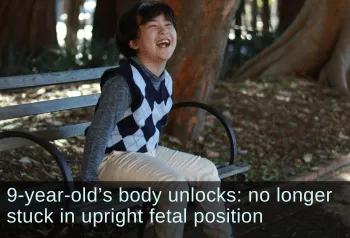
This young boy with autism, ADHD, and severe anxiety had so much tension and discomfort in his body that he was unable to sit normally—instead maintaining an upright fetal position sitting on his haunches. After his mother provided rhythmic movements and reflex integration from the Brain and Sensory Foundations course, his body unwound and he could sit properly for the first time. He also had notably less anxiety and tics, and his attention, coordination, and willingness to try new things improved.
Submitted by C.D., parent
| Before | After |
|---|---|
| Always struggled to sit comfortably on his bottom, regardless of the surface; preferred to sit on his haunches, legs tucked in close, in an upright fetal position | Can now sit comfortably on sit bones |
| Difficulty with coordination; avoidance of movement challenges | Body awareness has improved; movements are less rigid and more coordinated |
| Exhibited tics when anxious, fatigued, or faced with unfamiliar demands | Tics have reduced notably, only appearing when very upset and dysregulated |
| Experienced anxiety when faced with unfamiliar demands; avoidance of new situations | More willing to try new things |
| Often felt overwhelmed by the world around him | Anxiety no longer dominates his life; better able to recover from dysregulation |
| Transitions, new activities, and tasks that require sustained focus were difficult | Able to engage in activities with a sense of peace and comfortable attention for longer periods; more resilient when tasks are hard |
PD is my 9-year-old son. He is autistic and also diagnosed with ADHD and Tourette’s syndrome. From a very young age, PD has experienced intense anxiety, a strong fear of trying new things, and significant difficulty sustaining attention. Aside from the expected fine motor issues that are prevalent in his neurodivergent profile, he has always struggled to sit on his bottom comfortably regardless of how soft a surface I provide—we have some very interesting furniture in our home as a result—and has always preferred to sit on his haunches, legs tucked in close, in an upright fetal position. He is bright, thoughtful, and deeply sensitive, but his nervous system has often felt overwhelmed by the world around him and as he has grown, is now coming up against the physical limitations of his motor skills as they are and this year, has started refusing social outings (even the simplest things) due to fear of needing to sit somewhere where his sitting posture might be perceived or criticised.
As we home educate, I have the privilege of spending a great deal of time with PD and observing his patterns closely. I see how his anxiety shows up not just emotionally, but physically—through tension in his body, avoidance of movement challenges, difficulty with coordination, and an almost constant state of vigilance. His tics tend to increase when he is anxious, fatigued, or faced with unfamiliar demands. Transitions, new activities, and tasks that require sustained focus have historically been especially difficult for him. It was very clear to me that the therapeutic approach that we had always used to support him was missing something—it is for this reason that I decided to do a deep dive into movements that heal, being somewhat familiar with Dr. Blomberg’s work (I am a Play Therapist) and am beyond thrilled with the [Brain and Sensory Foundations] course and how its contents have genuinely changed our lives, especially PD’s.
I began incorporating rhythmic movements [from the Brain and Sensory Foundations course] into our daily routine as part of our play time. Heart connection is our natural language in our home so adapting the movements according to his play preference was easily received. I was a little sceptical at first but within a week, I noticed a pretty dramatic decrease in his baseline anxious affect. He also started to request the movement games [from the Brain and Sensory Foundations course], and soon, we were including rhythmic movements at various times where he naturally sought regulation, especially at bed time.
I decided to introduce the 5-Step Balance [from the Brain and Sensory Foundations course] into our daily routine early on in our process of using movements with him, as he responds very well to more structured activity. I would start by using the 5-Step Balance when moving through our daily activities as he finds transitions very dysregulating. Afterwards he’d happily move on to his next activity, such as from his desk to the piano. This [5-Step Balance] became a daily activity along with the rhythmic movements and at least a month passed enjoying these new structures together.
From the beginning, my priority was not performance or compliance, but developing a sense of security around this practice and connection with him. I understood that PD’s nervous system needed to feel secure before any meaningful learning or physical integration could take place.
Once we were doing rhythmic movements comfortably and happily on a fairly regular basis, and once PD had accepted the 5-Step Balance process, I saw a window to start investigating his retained reflexes and trying relevant isometric movements. Initially, we worked in very small doses—often just a few minutes at a time. Many of the movements were passive, with me guiding his body while he sat up in close proximity to me as he was too anxious to lay down without continuous motion being available to him, even if that motion is gentle as it is with the rhythmic movements. At first, PD’s body was extremely tense and his responses to reflex stimuli very notable and clear and at times producing emotional responses. He had difficulty allowing his head and limbs to move freely, and he often wanted to stop quickly. I followed his lead, always stopping when he asked, and focused on building trust rather than pushing.
It became clear very early on that he needed the most support around the Fear Paralysis reflex as well as Moro (though these are not the only primitive reflexes that remain active in him) and so I started adding in integration movements and activities with great caution and respect for his tolerance. I started using the Fear Release Tapping technique [from the Brain and Sensory Foundations course] with him whilst he was engaged in reading a book or doing a puzzle next to me on the bench—as ever, he would be sitting upright in a tight fetal position. At first, he would only accept this (happily!) when I concentrated my tapping around his feet and ankles. After about a month, his posture ‘unlocked’ and he started leaning into me whilst sitting, moving down onto the buttock closest to me. This was a huge change for him and he soon started accepting the tapping on the side of his body exposed on the far side, allowing me to alternate the tapping sequence with gentle joint compression of his fingers, wrist and shoulder on that side. After a while, I noticed him starting to rock into me, eventually straightening both legs and sitting fully on his sit bones. I was then able to add an activity relating to Headrighting as part of this ‘cycle’ of passive movement as it seemed like that was where his little body wanted to ‘go’ next, always returning to tapping and compression. After a period of about 2 months of this cycle every day, PD would sit comfortably on his sit bones, not needing to have me near, able to engage with his activity with a sense of peace and comfortable attention for much longer than previous. A great success for him and for our family life!
Additionally, his body awareness has improved. His movements became less rigid and more coordinated and he is now able to verbalise when he feels tense. His tics have also reduced notably, and only appear when he is really upset and dysregulated. While anxiety is still part of his life, it no longer dominates him in the same way when it comes to sitting and engaging his attention. He is more willing to try new things, more resilient when tasks are hard, and better able to recover when he becomes dysregulated. He is currently enjoying using his 5-Step Balance to help him with his personal hygiene which has never been easy to do for his highly sensitive skin. Our bond of safety—built through consistent presence, respect for his limits, and shared movement—has been central to this growth. This has given us and him a strong framework to keep growing and developing healthily.
(Edited, emphasis added)
*Disclaimer: The activities in the Brain and Sensory Foundations curriculum make use of the natural processes of neuroplasticity and development that are innately wired in the design of human beings to promote maturity and function. These activities appear to calm, organize, and mature the neuro-sensory-motor systems just as we see in the healthy development of human infants. Individual results may vary, and we do not claim to offer a diagnosis or cure for any specific condition or disorder. The Brain and Sensory Foundations activities appear to improve overall functioning resulting in measurable improvements for a range of conditions as demonstrated in over 1800 case studies from participants.