

Primitive Reflex Integration Case Studies
Reflex Integration Supports Fine Motor Skills Acquisition
School-based therapist helps preschooler with autism to improve eye-hand coordination
This young boy exhibited fine-motor as well as visual-motor challenges, such as using scissors and drawing pre-writing shapes without maximum visual cues. After receiving rhythmic movements and integrating his Asymmetrical Tonic Neck Reflex, he made notable improvements in all areas, and could cross midline more easily.
Submitted by Liezel Gatliff, COTA/L
| Before | After |
|---|---|
| Difficulty with visual motor integration | Able to cross visual midline when drawing |
| Difficulty using coordinating hands | Using both hands together much better; can cut a circle with minimal prompts to shift |
4-year-old male with autism. School-based OT goals include drawing a horizontal line and circle and cutting a 6-inch line. Per OT report, student has difficulties with visual-motor integration. Fine-motor skills were noted to be average. Parent reported that student has difficulty with learning new motor skills. Per observations during OT sessions, I found that student had decreased attention.
After testing his reflexes, I concluded that he had a retained Asymmetrical Tonic Neck Reflex on the left side. Current OTR learned later that student had torticollis on the left side as an infant. This information was not stated on his OT report, which was done by a different therapist.
I began with rhythmic movements [from the Brain and Sensory Foundations course] to help with the attention and motor planning. After stimulating the ATNR, I tried the isometric activities, but his decreased attention made it difficult for him to maintain the positions, so we moved to more active integration, using the playful activities from the Brain and Sensory Foundations course. I chose these activities because they were fun enough to hold his interest while working on integrating the ATNR.
I knew that integrating the ATNR would be critical to his being able to achieve his cutting goal, as well as his visual motor goal of drawing a horizontal line and circle.
He has improved with drawing circles and is now able to draw most of his prewriting shapes given visual cues. You can see that he is able to cross visual midline to draw a horizontal line without the second visual cue (dot on the right side). He can cut a circle with minimal prompts to shift, but he’s using both hands together much better than when he started. He receives school-based OT 30 minutes a week. We start with the activities mentioned above first and have added some others. This is after approximately 14 sessions (there were some absences and breaks/holidays).
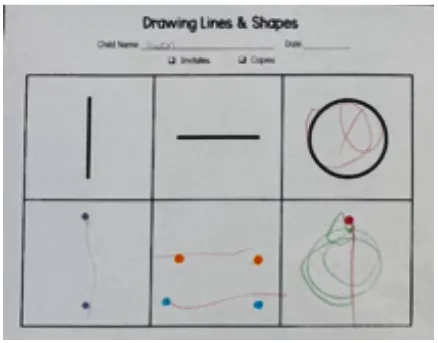
Work Sample 6/2025
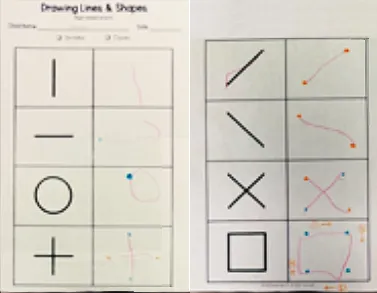
Work Sample 12/2025
I learned that the reflex integration activities helped my student gain skills at a faster rate than some of my other students who had the same goals and were about the same age and with whom I didn’t perform the reflex integration activities, because I work with them in the classroom and there is no space for me to do these activities.
(Edited, emphasis added)
*Disclaimer: The activities in the Brain and Sensory Foundations curriculum make use of the natural processes of neuroplasticity and development that are innately wired in the design of human beings to promote maturity and function. These activities appear to calm, organize, and mature the neuro-sensory-motor systems just as we see in the healthy development of human infants. Individual results may vary, and we do not claim to offer a diagnosis or cure for any specific condition or disorder. The Brain and Sensory Foundations activities appear to improve overall functioning resulting in measurable improvements for a range of conditions as demonstrated in over 1800 case studies from participants.