How Neurodevelopmental Movements Can Improve Mental Health Outcomes
Learn how primitive reflex integration and developing the sensory systems can greatly improve regulation, focus, and mental health.
by Sonia Story, M.S.
A young man in our community recently shared that he has been trying to get mental health therapy, but without success. Eight different therapists have sent him away because their schedules were full!
Is this happening in your community too? While there is a severe shortage of mental health therapists, especially for children, there also appears to be an overwhelming need given rising rates of issues like anxiety and depression.
Did you know that many occupational therapists are seeing gains in mental and emotional health when they apply neurodevelopmental movements for sensory issues? A number of mental health professionals are successfully using neurodevelopmental movements too. Wouldn't it be wonderful if all of the professionals in the mental health field knew about this?
You can be a part of this change by sharing this article and the research here with the school counselors and mental health professionals in your community.
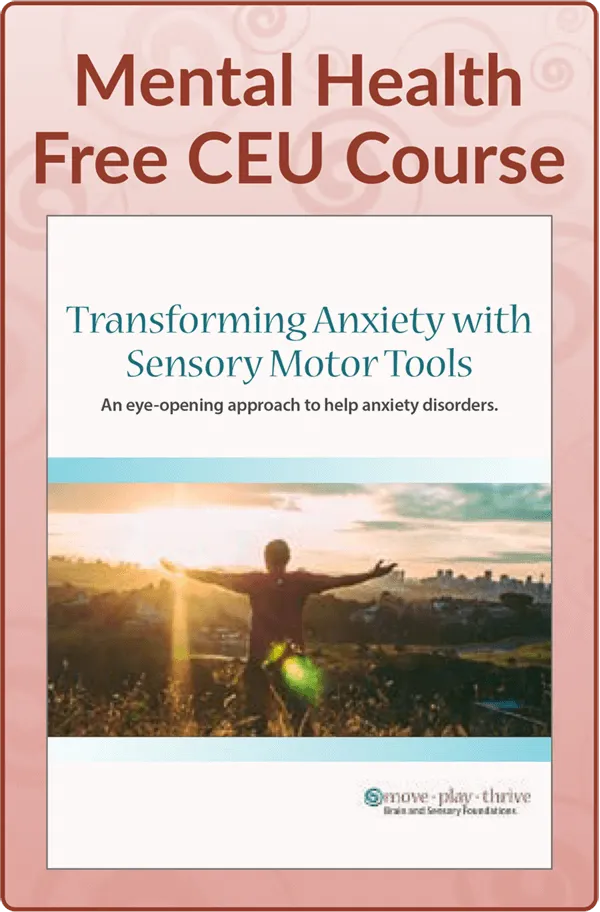
Because of the work of trauma specialists Bruce Perry, M.D. and Bessel van der Kolk M.D., many mental health therapists already recognize that standard talk therapy methods for addressing challenges may be useful for some individuals, but often do not go deeply enough to resolve underlying nervous system challenges, such as constant states of fight, flight, or freeze. In fact, standard cognitive behavioral interventions were not as effective as expected for children with severe anxiety, trauma, and neglect; and the researchers recommended a more developmentally-based approach (Prather and Golden, 2009). This FREE 1-hour course explains how mental health therapists can utilize developmentally-based sensory-motor tools to transform anxiety.
Get innovative ways to help with anxiety in this free one-hour training. In this training, you will get innovative ways to help with anxiety and related challenges. You will hear from mental health therapists about how they are resolving anxiety using brain-based sensory-motor input. You will gain an understanding of why these tools work, and get a fast-acting calming strategy to use with clients.
CEU credit of 1 hour is awarded for completion of this training for Licensed Professional Counselors in Texas. For mental health therapy professionals in other USA jurisdictions, inquire with your licensing board.
Neurodevelopmental Movements Impact Mental Health
When I first began learning about neurodevelopmental movements, their profound and rapid effects on development and functioning really struck me. After resolving my own issues with anxiety through the use of these movements, I set out to help children with learning challenges and ADHD. At the time, I thought that would be the extent of my reach.
However, like anyone who uses these tools consistently, I soon saw that neurodevelopmental movements were transformative for individuals on so many levels—physical, social, emotional, and cognitive. Not only did I see improvements in learning and the reduction of ADHD symptoms, these innate movements seemed to greatly boost well-being and resolve mental health issues like trauma, anxiety, compulsive disorders, and depression.
I was stunned by the positive outcomes that came again and again, without fail.
My colleagues also reported similar results with their clients. I came to realize that by giving innate neurodevelopmental movements, the principles of development and neuroplasticity are engaged to mature and organize the brain, body, and sensory systems. This integrated, balanced maturity promotes functional gains. When someone is more functional, it is natural that their mental health improves. Many of these themes have been described in research with infants, children, and elderly individuals. Unfortunately, the opposite situation is true also: When neurodevelopmental movements are left in an immature state, it is associated with dysfunction.
For example, researchers have long known that mental health and behavioral issues in children are often linked to poor development. In a 1982 study, retained primitive reflexes—a neurological sign of incomplete development—were associated with childhood psychopathology.
Supporting Research
In fact, decades of research have shown that under-development, in the form of retained (or reactivated) primitive reflexes, is associated with the following behavioral and mental health conditions:
- Poor attention and opposition-defiance (Hickey & Feldhacker, 2022)
- Weak emotional regulation (Grzywniak, 2017)
- Anxiety (Carter, 2020; Forrest, 2002)
- Schizophrenia (Hyde et al., 2007; Murray et al., 2006)
- Mania (Mehta et al., 2019)
- Agoraphobia and Panic Attacks (Morgan-Brown, 1997)
- Social and language impairments (Bradshaw et al., 2023; McPhillips et al., 2014)
- ADHD (Wang et al., 2023; Bob et al., 2021; Konicarova et al., 2014; Konicarova & Bob, 2013; Konicarova et al., 2013; Taylor et al., 2004)
- Severe emotional and behavioral challenges (Taylor et al., 2020)
- Perceived stress and hopelessness (Stephens-Sarlós et al., 2024)
Today's Children Are Showing Signs of Poor Development
It appears that a large majority of children are suffering with incomplete development, or what Sally Goddard Blythe calls, “neuro-motor immaturity.” Here is a shocking statistic: In recent studies, researchers found that close to 90% of today’s school-age children have retained primitive reflexes and/or underdeveloped neuro-sensory-motor skills (Goddard Blythe, et al., 2022; León-Bravo et al., 2023). Children today are also much less capable of self-regulation than they were 40 years ago (Spiegel, A., 2008, as quoted in Stafford Son, 2023). When under-development is present, it often manifests as sensory processing challenges (Pecuch et al., 2020). This is hugely significant because hypersensitivities can be very uncomfortable, and researchers have found that over-responsiveness to sensory input appeared to be causally linked to anxiety in both typical children and children with ADHD (Lane & Reynolds, 2019). Read more about the "sensory-anxiety connection".
In an ideal world, all children would receive neurodevelopmental movements before problems arise with mental health, learning issues, and poor self-esteem.
How Can Simple Movements Address Mental Health Issues?
To answer this question, here is a summary of what appears to be happening: First, we use the neurodevelopmental movements to help children and adults become comfortable and capable physically. These movements naturally release muscle tension and promote maturity and improvements in balance, sensory processing, coordination, core strength, and rhythm. These movements also mature and allow the nervous system to let go of fight, flight, and freeze states. See the following examples:
This 10-year-old boy was unable to initiate conversations at school or make eye contact, and would freeze when spoken to. After his OT introduced rhythmic movements and primitive reflex integration, his anxiety greatly reduced and he is now able to make eye contact, communicate, and he is even participating in imaginative, creative play with another student. Read about his transformation here.
Jayden, a little boy with a history of birth trauma, sensory issues, developmental delays, and escalating violent tantrums, experienced profound improvement through primitive reflex integration and rhythmic movements from the Brain and Sensory Foundations program. See the difference!
These gains in sensory-physical maturity can both prevent and address anxiety, depression, and behavioral issues. One of my favorite examples involves an 8-year-old boy whose remarkable story was sent to me from his occupational therapist. In the slide to the left, notice this boy’s sensory-physical gains go hand-in-hand with emotional gains and huge improvements in behavior.
Neurodevelopmental movements are hugely supportive for mental health in adults too. Here is an example from an OT whose well-being was transformed by the movements from the Brain and Sensory Foundations course:
"I feel that I have been in fight or flight/running on cortisol for the past 30 years. I was close to a nervous breakdown last year, having multiple panic attacks, and could not leave my home...I felt helpless and exhausted... This course has helped me release shame around my own dysregulation and…truly feel safe in my own body in the first time in 31 years. This course has helped me to feel that fire again/passion for my career and I am forever grateful! I truly feel present when I use these [Brain and Sensory Foundations] tools and I am excited to help so many others from my own experience.” —Amanda R., MOT, OTR/L
Neurodevelopmental Movements Bring Resiliency
While there are many possible factors that could contribute to mental health challenges, including traumatic events, poor gut health, toxic exposures, poor sleep, etc., it appears that a proper neurodevelopmental movement foundation can help us to recover from stress, anxiety, and trauma while developing the resiliency needed to face life’s inevitable challenges.
Based on nearly 20 years of experience, I believe neurodevelopmental and integrative movements are among the best tools we have for turning around mental health challenges because they:
- Release stress
- Promote parasympathetic nervous system functioning
- Develop better balance and postural control (Note: According to Bart et al., 2009, improving balance reduces anxiety and increases self-esteem in children).
- Help us to become free of chronic fight, flight, and freeze states
- Calm and mature the sensory processing systems
- Help us to reach our goals with much greater ease and enjoyment
Research validates these observations. Integrating reflexes has resulted in;
- Improvements in social-emotional functioning in children (Grigg et al., 2018; Grzywniak, 2017)
- Improvements in self-regulation in children (Overvelde, 2022)
- Increases in well-being and cognitive skills in adults over 60 (Stephens-Sarlós et al., 2024)
Given the research showing gains from the use of neurodevelopmental movements, as well as the large body of consistently positive anecdotal evidence, it makes sense to include these innate movements as part of standard care in mental health. The mental health practitioners I know strongly agree because they see these movement tools working wonders for their clients. An example is shown in the slide to the left.
Imagine a world where mental health therapists regularly use these simple yet profound movement tools to facilitate deep and lasting transformation for those who are struggling. We are not there yet, but together we can build this dream into a reality.
How can we usher in a new era in mental health where neurodevelopmental movements become part of the standard of care for those struggling with mental health challenges?
How can we bring the extraordinary benefits of neurodevelopmental movements into the awareness of more mental health professionals?
Here is what you can do to help:
- Please let the mental health therapists in your community know about the Brain and Sensory Foundations training. As far as I know, this is the ONLY primitive reflex training that offers CEUs for mental health therapy professionals via NBCC. Share this article and our free mental health resources page.
- Consider enrolling in the Brain and Sensory Foundations course if you have not already joined. Whether your reach is large, small, or just within your own family, by using these tools you will be helping to make the world better and easier for those you serve.
I often give thanks for the gift of these neurodevelopmental movements and I pray that every child gets access to them in infancy and beyond. I welcome your participation with me in these efforts!
References
Bart, O., Bar-Haim, Y., Weizman, E., Levin, M., Sadeh, A., & Mintz, M. (2009). Balance treatment ameliorates anxiety and increases self-esteem in children with comorbid anxiety and balance disorder. Research in Developmental Disabilities, 30(3), 486-495.
Bob, P., Konicarova, J., & Raboch, J. (2021). Disinhibition of primitive reflexes in attention deficit and hyperactivity disorder: Insight into specific mechanisms in girls and boys. Frontiers in Psychiatry, 12.
Bradshaw, J., Shi, D., Federico, A., Klaiman, C., & Saulnier, C. (2023). The pull-to-sit task: examining infant postural development in autism spectrum disorder. The Journal of Pediatrics, 253, 225-231.
Carter, T. L. (2020). An exploration of the relationship between unintegrated primitive reflexes and symptoms of anxiety in children between 10-13 years in the Western Cape Province of South Africa [Doctoral dissertation. University of South Africa].
Forrest, D. S. (2002). Prevalence of retained primitive reflexes in patients with anxiety disorders. [Doctoral Dissertation, Annexe Thesis Digitisation Project 2017 Block 16.]
Goddard Blythe, S., Duncombe, R., Preedy, P., & Gorely, T. (2022). Neuromotor readiness for school: The primitive reflex status of young children at the start and end of their first year at school in the United Kingdom. Education 3-13, 50(5), 654-667.
Grigg, T. M., Fox-Turnbull, W., & Culpan, I. (2018). Retained primitive reflexes: Perceptions of parents who have used Rhythmic Movement Training with their children. Journal of Child Health Care, 22(3), 406–418.
Grzywniak, Celestyna. (2017). Integration exercise programme for children with learning difficulties who have preserved vestigial primitive reflexes. Acta Neuropsychologica. 15. 10.5604/01.3001.0010.5491.León-Bravo, G., Cantarero-Carmona, I., & Caballero-Villarraso, J. (2023). Prevalence of active primitive reflexes and craniosacral blocks in apparently healthy children and relationships with neurodevelopment disturbances. Children, 10(6), 1014.
Hickey, J., & Feldhacker, D. R. (2022). Primitive reflex retention and attention among preschool children. Journal of Occupational Therapy, Schools, & Early Intervention, 15(1), 1-13.
Hyde, T. M., Goldberg, T. E., Egan, M. F., Lener, M. C., & Weinberger, D. R. (2007). Frontal release signs and cognition in people with schizophrenia, their siblings and healthy controls. The British Journal of Psychiatry, 191(2), 120-125.
Konicarova, J., & Bob, P. (2013). Asymmetric tonic neck reflex and symptoms of attention deficit and hyperactivity disorder in children. International Journal of Neuroscience, 123(11), 766-769.
Konicarova, J., Bob, P., & Raboch, J. (2014). Balance deficits and ADHD symptoms in medication-naïve school-aged boys. Neuropsychiatric Disease and Treatment, 85.
Konicarova, J., Bob, P., & Raboch, J. (2013). Persisting primitive reflexes in medication-naïve girls with attention-deficit and hyperactivity disorder. Neuropsychiatric Disease and Treatment, 1457.
Lane, S. J., & Reynolds, S. (2019). Sensory over-responsivity as an added dimension in ADHD. Frontiers in Integrative Neuroscience, 13, (40)
McPhillips, M., Finlay, J., Bejerot, S., & Hanley, M. (2014). Motor deficits in children with autism spectrum disorder: A cross-syndrome study. Autism Research, 7(6), 664-676.
Mehta, U. M., Sanjay, T. N., Venkatasubramanian, G., & Muralidharan, K. (2019). Cortical inhibition and primitive reflexes in remitted first-episode mania. Brain Stimulation: Basic, Translational, and Clinical Research in Neuromodulation, 12(4), 1093-1094.
Morgan-Brown, M. (1997). An association of the asymmetrical tonic neck reflex (ATNR) and agoraphobia and panic attacks. British Journal of Occupational Therapy, 60(5), 223-225.
Murray, G. K., Jones, P. B., Moilanen, K., Veijola, J., Miettunen, J., Cannon, T. D., & Isohanni, M. (2006). Infant motor development and adult cognitive functions in schizophrenia. Schizophrenia Research, 81(1), 65-74.
Overvelde, S. (2022). Primitive Reflexes and Self-Regulation: Correlations Between them and the Potential Impact of Rhythmic Movements on Both (Master's thesis, Queen's University, Canada).
Pecuch, A., Gieysztor, E., Telenga, M., Wolańska, E., Kowal, M., & Paprocka-Borowicz, M. (2020). Primitive reflex activity in relation to the sensory profile in healthy preschool children. International Journal of Environmental Research and Public Health, 17(21).
Prather, W., & Golden, J. A. (2009). A behavioral perspective of childhood trauma and attachment issues: Toward alternative treatment approaches for children with a history of abuse. International Journal of Behavioral Consultation and Therapy, 5(1), 56.
Spiegel, A. (2008, February 21). Old-fashioned play builds serious skills. National Public Radio. http://www.npr.org/templates/story/story.php?storyId=19212514
Stafford Son, J. (2023, September 25). Youth Play & Health, Week 6 lecture, PowerPoint slides11, 12).
Stephens-Sarlós, E., Toth, E., Ihász, F., Alföldi, Z., Somogyi, A., & Szabo, A. (2024). Changes in primitive reflexes in older adults and their relationship to mental health indices: An experimental investigation. Experimental Gerontology, 196, 112583.
Taylor, B., Hanna, D., & McPhillips, M. (2020). Motor problems in children with severe emotional and behavioural difficulties. British Journal of Educational Psychology, 90(3), 719–735.
Taylor, M., Houghton, S., & Chapman, E. (2004). Primitive reflexes and attention-deficit/hyperactivity disorder: Developmental origins of classroom dysfunction. International Journal of Special Education, 19(1), 23-37.
Wang, M., Yu, J., Kim, H. D., & Cruz, A. B. (2023). Attention deficit hyperactivity disorder is associated with (a) symmetric tonic neck primitive reflexes: a systematic review and meta-analysis. Frontiers in Psychiatry, 14, 1175974.
Sonia Story, M.S. has been teaching neurodevelopmental movements since 2006.
Sonia developed the Brain and Sensory Foundations program to provide comprehensive training in neurodevelopmental movements—combining innate rhythmic movements, play, primitive reflexes, and postural reflexes.
She earned a Bachelor's degree in biology/psychology and a Master’s degree in Movement Sciences. She is the author of The Importance of Reflex Integration and the Evidence eBook, giving the rationale and evidence basis for using neurodevelopmental movements for helping with challenges such as ADHD, Sensory Processing Disorders, anxiety, emotional dysregulation, visual skill deficits, poor social skills, gross and fine motor delays and other neurodevelopmental and behavioral disorders.
Her work is featured in numerous podcasts, summits, and conferences, and in the books Almost Autism: Recovering Children from Sensory Processing Disorder; Special Ed Mom Survival Guide; Family Health Revolution; and Same Journey, Different Paths—Stories of Auditory Processing Disorder.
Sonia’s mission is to help children and families experience the profound benefits of neurodevelopmental and integrative movements for more functional and fulfilling lives.