Sonia’s Insights: Deep Dive into Development
New Research Validates Rhythmic Movements
Why Rhythmic Movements Are Essential for Child Development, Learning, and Brain Maturity
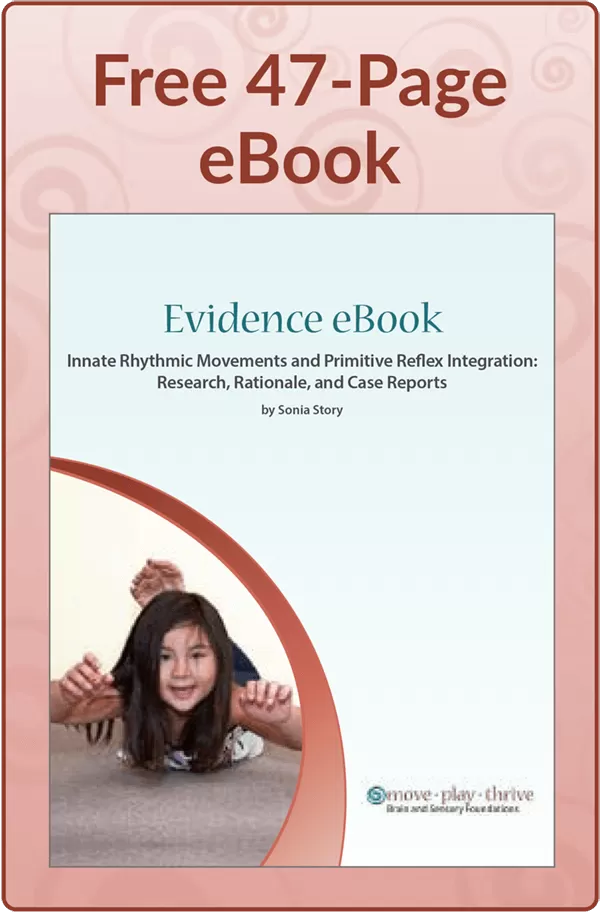
See research and case study evidence showing how innate rhythmic movements can help children with ADHD, dyslexia, autism, learning delays, and other neurodevelopmental challenges.
By Sonia Story, M.S.
Did you know that a lack of rhythmic ability is associated with many neurodevelopmental challenges? The link between poor rhythmic ability and ADHD sysmptoms is so strong that checking for rhythmic ability is considered a biomarker for diagnosing ADHD (Gustafsson et al., 2023). Deficits in rhythmic ability are linked to the following challenges:
- Autism (Lense et al., 2021)
- Speech and language disorders (Lense et al., 2021; Ladányi et al., 2020)
- Developmental coordination disorder (Lense et al., 2021; Ladányi et al., 2020)
- ADHD symptoms (Lense et al., 2021; Ladányi et al., 2020)
- Dyslexia (Ladányi et al., 2020)
Developing rhythmic ability is something human beings are supposed to accomplish in infancy and early childhood. This training in infancy for rhythmic ability likely comes from many sources. In the womb, the growing infant recognizes the mother’s heartbeat, breathing, voice, and walking—and modifies its own behavior in response to the mother’s rhythms (Provasi et al., 2021). In the womb and after birth, a healthy newborn engages in rhythmic sucking. Parents instinctively bounce and rock their babies in a rhythm. Rhythm is so important to development that human babies are also designed to spontaneously move in rhythmic fashion. Healthy babies do many types of innate rhythmic movements that drive their growth in infancy.
Unfortunately, there are so many things in our modern lives that hinder the development of infants, and many children miss out on the full spectrum of innate movements they need to thrive.
Here is the hopeful part: We can give the innate rhythmic movements later in life to continue the developmental process, integrate reflexes, and build the foundation for better function. These simple yet powerful innate rhythmic movements amaze me because they work so well and seem to have major benefits for global maturation—physically, socially, emotionally, and cognitively. Professionals and parents are thrilled with the results (see the comments and remarkable videos below). The innate rhythmic movements are calming and organizing, and as long as we honor the pace of the child, children want to do these movements and often ask for more.
There is new research validating the use of innate rhythmic movements for helping children with challenges. During development these innate rhythmic movements have a key role in maturing the body, the primitive and postural reflexes, the brain, and the sensory-motor systems. Without these innate rhythmic movements, full and proper development is not possible. When infant development is compromised, it can leave our children with challenges like weak muscles, underdeveloped sensory systems, poor reflex integration, poor posture, depression, inefficient brain development, anxiety, ADHD, and behavior issues.
Here are three research studies that validate the power of rhythmic movements like the kind we teach in the Brain and Sensory Foundations course:
- Pérez-Rey et al., (2024) found that an 11-week program of rhythmic movements (six times per week, 10 to 15 minutes including rest between movements) was associated with better balance and reading ability for children with dyslexia.
- Grigg et al., (2023) used innate rhythmic movements and found that doing as little as five minutes per day, four times per week, integrated primitive reflexes and increased reading scores in school children, from ages six to eight years.
- Another study used innate rhythmic movements along with balance, and whole-body coordination activities to integrate primitive reflexes for children with ADHD and ASD. The authors found that they were able to achieve reduction in the levels of retained (unintegrated) primitive reflexes; at the same time, there were significant reductions in ADHD symptoms for the children with ADHD (Hirose et al., 2025).
Students of the Brain and Sensory Foundations Course regularly tell me these innate rhythmic movements are game changing:
"Having taken other courses on primitive reflexes, I was particularly drawn to this one because of its unique focus on rhythmic movements. This component was the missing piece in my practice! Since incorporating rhythmic movements into my intervention strategies, I've observed remarkable improvements in reflex integration and skill acquisition."
Jessica Powell, Occupational Therapist"Most of my students really enjoy the rhythmic motions and ask for it during our sessions."
Kelly McDonald, PTA"The rhythmic movements have been integrated into our practice with most success to increase functional engagement when the kiddos can't seem to relax otherwise. They are also proving to be the gateway for motor development—amazing results where other interventions were not even close to helping. The kiddos love the "work" and the parents are relieved to find bedtime movements that relax everyone!
Trish LaCour, OTD, OTR/L
Check out the case study and videos from OT professionals below for more on the remarkable benefits of innate rhythmic movements.
I often wish I had a giant megaphone to "shout from the rooftops" to get the word out about these important innate rhythmic movements for our children's development and well-being. Please share this article with your friends and colleagues.
Rhythmic Movements Help Resolve Car Sickness
Read about how this adult therapist went from extreme and frequent car sickness to being able to read in the car without nausea. Read the full case study here.
"I am helping kids experience success like I’ve never seen."
Just a few minutes per day of reflex integration and simple innate movements from the Brain and Sensory Foundations course dramatically improved handwriting, oral reading fluency, sensory processing and more for the clients of Lynda Steed, OTR/L. See this 2.5-minute video about how rhythmic movements and primitive reflex integration have "totally changed" Lynda's outcomes.
Measurable changes in one school quarter!
Peggy McCahan, OTA/L gave four passive rhythmic movements, (one minute each for a total of four minutes, 5 times per week) individually to each of eight children in a self-contained classroom, ages 8 to 12. McCahan found that all students made progress on their OT goals even though they had not been receiving any other OT intervention! (McCahan, P., 2023). Hear Peggy's story.
Thank you for reading and sharing this and for being on the journey with me to help our children thrive.
References
Gustafsson, P., Kjell, K., Cundari, M., Larsson, M., Edbladh, J., Madison, G., ... & Rasmussen, A. (2023). The ability to maintain rhythm is predictive of ADHD diagnosis and profile. BMC Psychiatry, 23(1), 920.
Lense, M. D., Ladányi, E., Rabinowitch, T. C., Trainor, L., & Gordon, R. (2021). Rhythm and timing as vulnerabilities in neurodevelopmental disorders. Philosophical Transactions of the Royal Society B, 376(1835), 20200327.