

Sonia’s Insights: Deep Dive into Development
Reversing Learning Challenges
Building Better Learning from the Ground Up
Have you noticed that learning challenges in children seem to be more common, more pervasive, and more difficult to address than ever before? There are underlying reasons we explore in this article—along with simple, effective methods for reversing learning challenges.
By Sonia Story, M.S.
I recently got an email from an educator who wanted to know how to help a boy at her school who:
- Gets easily distracted
- Has motion sickness
- Props his head on hands while sitting
- Walks on toes
- Has not established hand dominance
- Has letter confusion
This list of challenges represents a child who has poor or incomplete development that makes learning difficult. Everything on the list is a sign that the brain, body, and sensory-motor systems are not fully developed or mature. It is not a lack of intelligence that holds children back from learning. Learning blocks are usually the result of immaturity in the neuro-sensory-motor systems that begin in early life.
It is distressing to think that a large majority of today's school children appear to have poor development, ranging from mild to severe, that can hinder the ability to learn with ease and enjoyment. A primary way to see if development is poor is to look for postural and motor deficits.
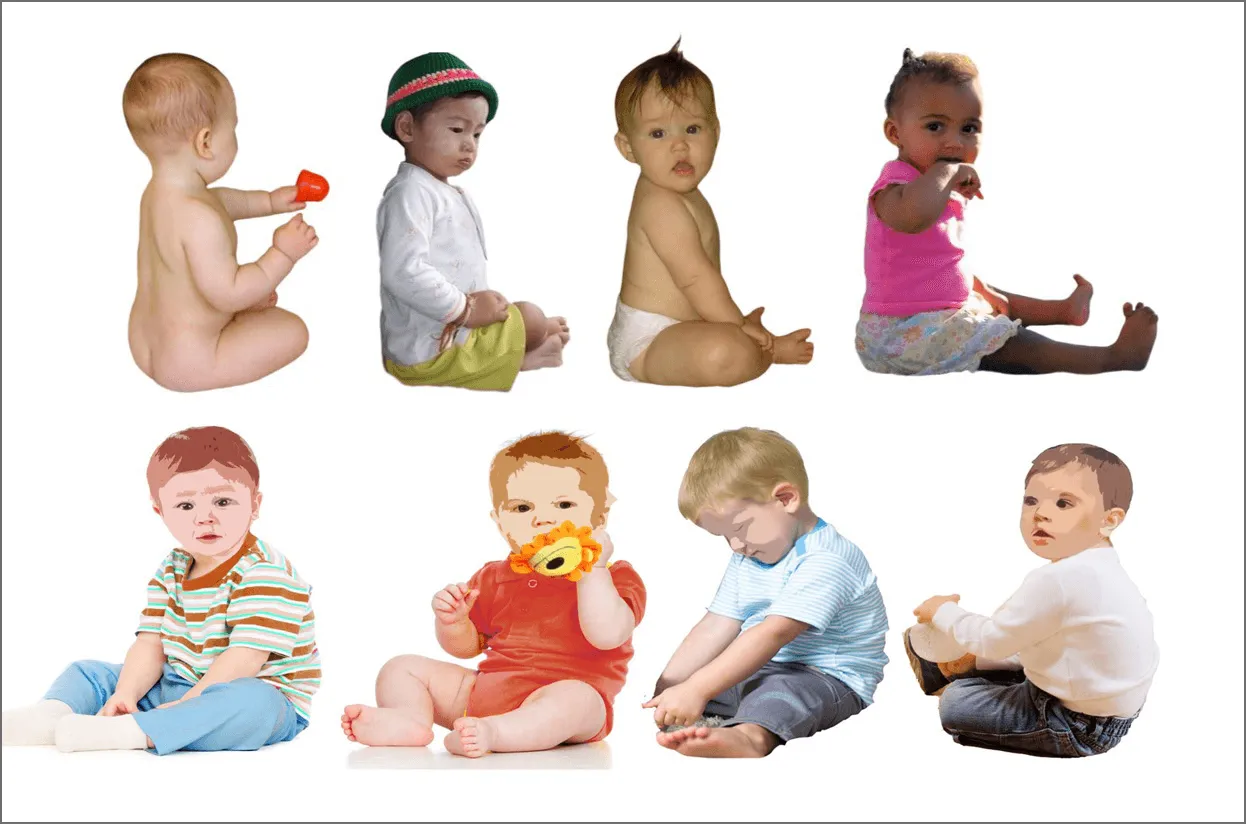 Photos from Kathleen Porter, author of "Healthy Posture for Babies and Children"This set of photos demonstrates that the postural and motor deficits that school children show have their beginnings in early development—that is when the foundations for core strength, posture, stamina, and attention should be built from the ground up, through the innate neurodevelopmental movements of infancy. But often these essential neurodevelopmental movements are missed, as we see in the slumped babies on the bottom panel of photos. The result is neuro-sensory-motor immaturities that can manifest in learning challenges once formal schooling begins.
Here we will explore:
- Alarming evidence showing how motor-deficits are very common in today's school children
- The link between motor deficits and learning challenges
- Why more practice and tutoring is often ineffective
- Research: How to help children access successful, stress-free learning
- Inspiring reports from a tutor using neurodevelopmental movements to reverse learning challenges.
- A FREE video resource you can share called "Get Ready for School"
Motor Deficits Are Very Common in School Children
If we spend time with young children in a school-based setting, we often notice that many children are easily distractible, constantly moving around, and unable to follow directions. The basis for attention and focus for school is a solid sensory-motor foundation. But so many children struggle with a lack of this developmental foundation. For example, Steven Kane, a school-based occupational therapist reported that when he assessed groups of children in regular fifth grade physical education classes, nearly all of the students were unable to perform an age-appropriate motor task (S. Kane, personal communication, 2011). One elementary school teacher recently wrote, "Out of 28 children we just assessed for first grade, only one showed neuro-readiness" (N. Gallwey, personal communication, May 26, 2023). These and similar reports have been validated by research teams:
- Out of 120 school children in the U.K. between the ages of four and five, only three had no signs of motor abnormality (Goddard Blythe, et al., 2022).
- In a study of apparently healthy children in Spain (ages 3-8) without neurological disability, 89.5% had retained primitive reflexes (León-Bravo et al., 2023).
- In a study of 27 preschool children (USA), 100% had at least one retained reflex (Hickey & Feldhacker, 2022).
Poor development and motor deficits are associated with learning challenges
Though there are many factors that could contribute to learning challenges, motor deficits are especially important to address because they impact the very core of our ability to pay attention, focus, learn, listen, write, read, and relate well with others—all of which are prerequisites for learning.
The relationship between motor deficits and learning disorders has been established in scientific literature. This research reveals that children with less mature motor skills perform less well on academic assessments (Goddard Blythe, 2018), are cognitively delayed relative to their peers, and experience more anxious and depressive symptoms (Piek et al., 2010).
Does this mean that we can simply get kids wiggling and running around more in school settings and it will fix the motor deficits?
Unfortunately no.
There are specific underlying neurodevelopmental movement patterns that need to be addressed in targeted, systematic ways to build the neuro-sensory-motor foundations for learning skills. These neurodevelopmental movements include innate rhythmic movements, primitive reflexes, and postural reflex movements.
 We know from research that retained (immature) primitive reflexes are strongly linked to both neuromotor immaturity and learning challenges. According to Goddard Blythe (2018), retained primitive reflexes are reliable indicators of neuromotor immaturity and immature neuromotor skills are significant factors in educational underachievement.
Primitive reflexes have many essential roles in the development of infants and young children, after which they should be dormant or inhibited by higher brain centers. When primitive reflexes are retained (still active and not dormant), the roles they were supposed to accomplish in early development are left unfinished.
The many purposes of primitive reflexes in infancy that are especially important to learning are the development of:
- Brain maturity and ability to focus
- Core strength and postural stability
- Vestibular maturity
- Auditory processing skills
- Visual skills
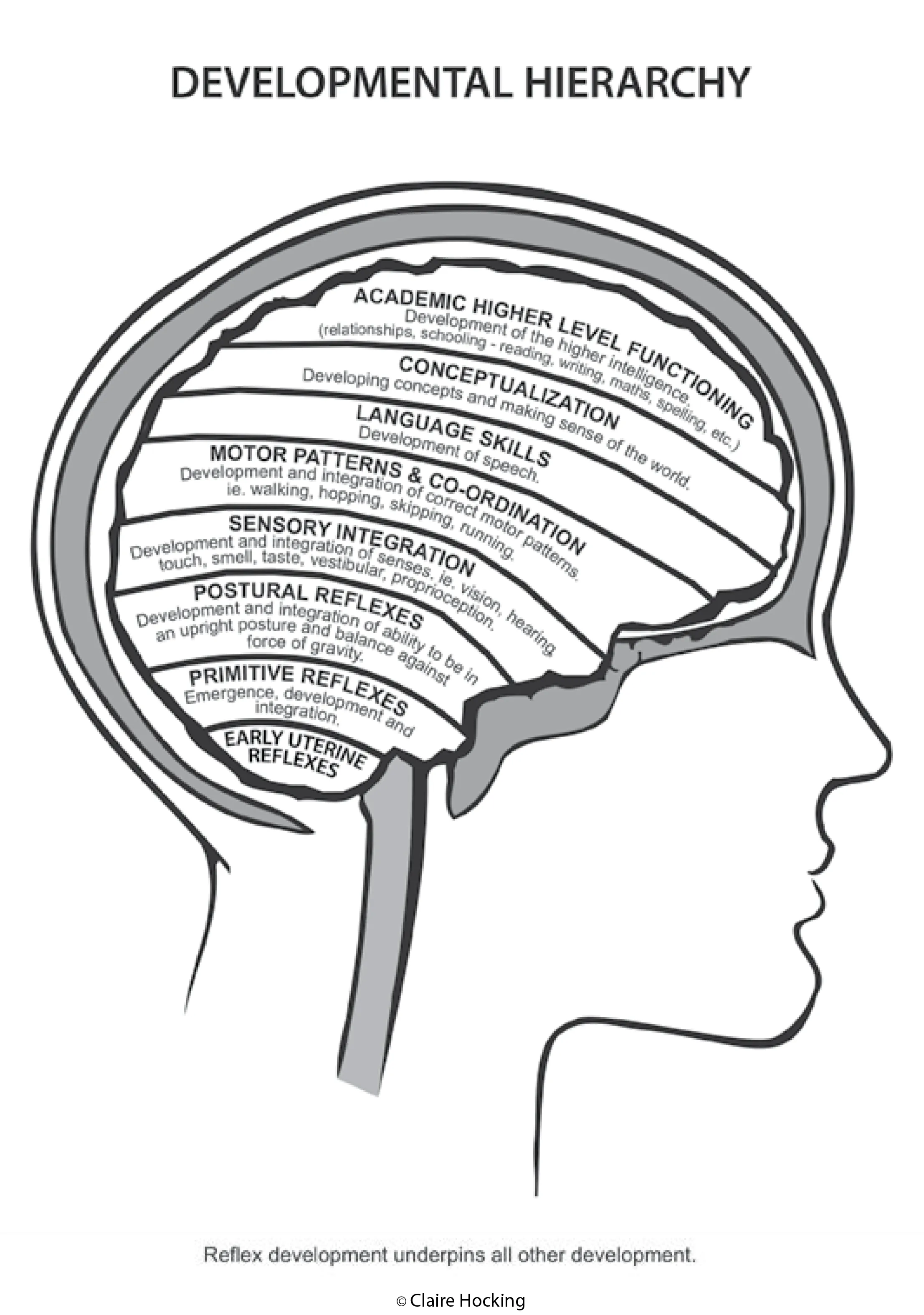
We need our postural stability in order to pay attention and for our sensory processing systems to work well together. We need our auditory and visual skills to develop well for nearly all life activities and especially for learning tasks. This developmental hierarchy graphic shows some of the stages of development that are required for being able to learn with ease. We can see why mature reflexes and sensory systems are required for efficient learning.
What about extra tutoring and more reading practice? Won’t that help?
Often by the time a child is 6 or 7 years old, it is common to assume that if a child is struggling to read, the remedy is to give more reading practice or tutoring.
For some children, it is helpful to get extra tutoring and reading practice. However, for many, extra practice doesn’t work and is a source of more stress. The stress builds because trying to read without basic visual motor skills and focus is so difficult and even with great effort, there is minimal progress. More practice in reading cannot remedy the underlying sensory-motor deficits.
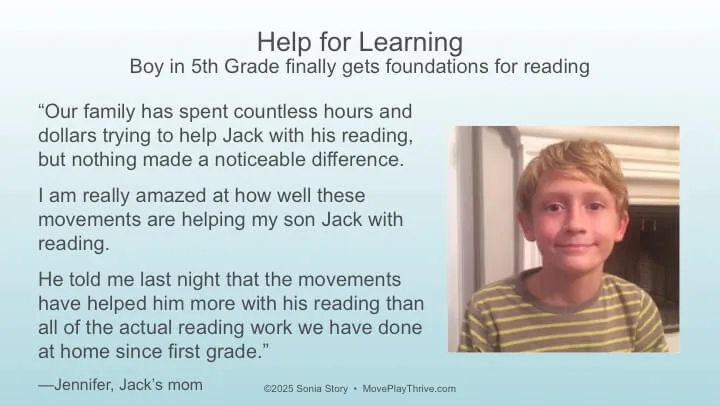
Consider the story of Jack who, despite high intelligence, years of tutoring, and regular reading practice, he could still not read in 5th grade. It was the innate rhythmic movements that made all the difference for Jack—and he knew it too. Read his mother’s report:
How to help children access effective, stress-free learning
Boosting the foundational neuro-sensory-motor development is how we can best help children to learn and function well in all capacities. There is no substitute for a calm and effective brain, body, and sensory system. Doing neurodevelopmental movements can be the most fun and effective way to establish the brain and sensory maturity needed for successful learning.
Attention, self-regulation, and learning ability are built from the ground up with the innate movements of early life. For example, research on the use of primitive reflex integration activities is associated with improvements in the following areas—all of which are helpful for learning:
- Vestibular maturity (Stephens-Sarlós, 2024)
- Visual motor skills (Domingo-Sanz, 2024; Domingo-Sanz, 2022)
- Visual and auditory processing (Stephens-Sarlós et al., 2024, August)
- Balance (Infante-Cañete et al., 2023; Jeong et al., 2021; Grzywniak, 2017; Niklasson et al., 2017; Wahlberg & Ireland, 2005)
- Coordination (Grzywniak, 2017; Niklasson et al., 2017)
- Motor skills (Infante-Cañete et al., 2023; Pecuch et al., 2021)
- Fine motor abilities (Brown, 2010)
- Posture defects (Jeong et al., 2021; Gieysztor et al., 2018, March)
- Reading (Grigg et al., 2023; McPhillips & Jordan-Black 2007; Wahlberg & Ireland, 2005; Jordan-Black, 2005; McPhillips et al., 2000)
- Headache reduction (Wahlberg & Ireland, 2005)
- Oculo-motor functioning (Bein-Wierzbinski, 2001, as quoted in Goddard, 2005)
- Mathematics (Jordan-Black, 2005)
- Copying ability (Brown, 2010)
- Writing speed (McPhillips et al., 2000)
- Concentration (Jeong et al., 2021)
- Cognitive function (Stephens-Sarlós et al., 2024, September)
- Social-emotional functioning (Grigg et al., 2018; Grzywniak, 2017)
- Self-regulation (Overvelde, 2022)
Like Jack’s mom in the example above, we can be sure that there are multitudes of mothers who are praying for answers to their children’s learning challenges. With neurodevelopmental movements there is hope. And real, evidence-based solutions that bring huge positive life changes.
Success Stories from a Dedicated Tutor
Janis Nakagama is a tutor who understands how delayed development gets in the way of learning. She embraces the neurodevelopmental movement tools and uses them with struggling students to create massive transformation:
"I’m a tutor for school-age children who struggle to read, many diagnosed with dyslexia. When my students practice the [neurodevelopmental] movements consistently, the changes are real and visible—better focus, steadier body control, stronger academic skills, and, most importantly, much more confidence! I’ve taken kids from near-failing or failing to Honor Roll and beyond. One student…had global delays and dyslexia; today, that same student is in high school taking AP and Honors classes—and is a math whiz! My students have often exceeded their IEP goals and even their stretch goals. Some students were told they did not need IEP’s anymore."
Second Grade Teacher Reports Remarkable Changes in Her Students
Rachel Croft reported the following observations after using movements from the Brain and Sensory Foundations course in her second grade classroom:
- Best growth in reading and math on average at midyear assessment for my class in 4 years. (I've only been at this grade with these assessments for 4 years.)
- Kid fixed very stubborn pencil grip spontaneously
- Kid with diagnosis and other challenging situations, who could not even one on one answer simple comprehension questions, volunteering in class to answer them
- Other teachers wondering what had changed with our mutual kids, without knowing what we were doing because of improved behavior and learning
- Kid sitting up straighter who was very collapsed
- Kids reporting movements have reduced their pain even though i didn't tell them that was a possibility!!
- They also reported improvements in ease of learning, application of learning, and regulation in and out of school.
Wow. Even the children are noticing the benefits and improvements! This is such a testament to the power of innate neurodevelopmental movements. With a commitment to doing these enjoyable movements with our children on a regular basis, we can give them a gift that will last a lifetime. Get inspired with another second grade teacher's story and video, as well as these examples:
Focus, Reading, Handwriting, and More Improve in 7 Weeks
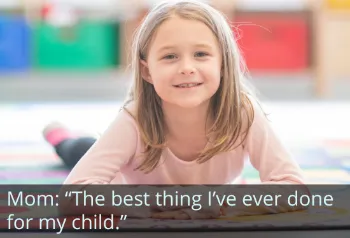
This little girl was struggling in and out of the classroom. Short attention kept her from finishing tasks and she had difficulty reading, spelling, and writing. Doing schoolwork exhausted her, yet she had trouble sleeping. Meltdowns were frequent. See how her Biokineticist and mom worked together to implement innate rhythmic movements and primitive reflex integration to see improvements to long-time issues in just 7 weeks.
Improved Writing, Focus, and Regulation After Reflex Integration
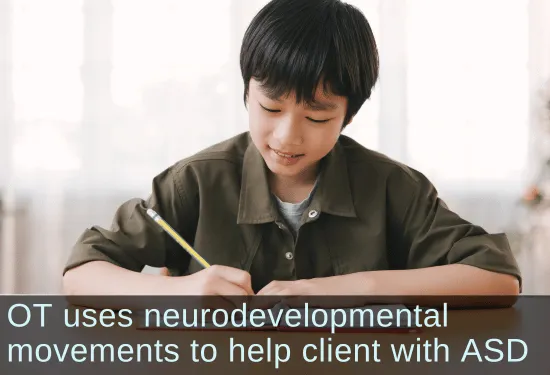
A 12-year-old boy with autism showed notable gains in handwriting, spelling, sustained focus, emotional regulation, balance, and midline crossing after rhythmic movements and primitive reflex integration. Find out about the improvements his parents, teachers, and OT observed.
Foundational Help for Attention, Anxiety, Visual Tracking, Speech, and More
Rhythmic movement and primitive reflex integration made a huge difference for this 7-year-old girl's attention, reading, speech, visual tracking, and confidence. Learn about improvements that were so profound, her OT commented, "I believe the rhythmic movements have allowed her brain to innately change itself without being forced…"
References
Goddard Blythe, S. (2018). Children's developmental needs should lead policy. Early Years Educator, 20(3), 22-24.
For all other references, go to the reference section at this link.

Sonia Story, M.S. has been teaching neurodevelopmental movements since 2006.
Sonia developed the Brain and Sensory Foundations program to provide comprehensive training in neurodevelopmental movements—combining innate rhythmic movements, play, primitive reflexes, and postural reflexes.
She earned a Bachelor's degree in biology/psychology and a Master’s degree in Movement Sciences. She is the author of The Importance of Reflex Integration and the Evidence eBook, giving the rationale and evidence basis for using neurodevelopmental movements for helping with challenges such as ADHD, Sensory Processing Disorders, anxiety, emotional dysregulation, visual skill deficits, poor social skills, gross and fine motor delays and other neurodevelopmental and behavioral disorders.
Her work is featured in numerous podcasts, summits, and conferences, and in the books Almost Autism: Recovering Children from Sensory Processing Disorder; Special Ed Mom Survival Guide; Family Health Revolution; and Same Journey, Different Paths—Stories of Auditory Processing Disorder.
Sonia’s mission is to help children and families experience the profound benefits of neurodevelopmental and integrative movements for more functional and fulfilling lives.