

Headaches
3 Reasons Primitive Reflex Integration Can Relieve Headaches
by Sonia Story
Blake’s mother brought her 8-year-old son to me to get help for the boy’s distractibility, angry outbursts, and learning challenges. I was shocked to find out that this young boy also complained of severe headaches several times per week.
For any given individual or condition, we cannot know for sure if primitive reflex integration will help until we try it. However, preliminary evidence is promising with research showing that reading-challenged children with headaches responded favorably to primitive reflex integration and reported a reduction in headaches while their reading scores also improved (Walhberg & Ireland, 2005). Further research is important, however, for those looking for a drug-free, zero-harm approach, it is good to know that primitive reflex integration is an effective option. Many children and adults have found relief from headaches and other conditions with primitive reflex integration. We will explore their stories here, but first, these are 3 reasons why primitive reflex integration may be especially helpful to overcome headaches:
1. Reducing Muscle Tension
Headaches may arise from excess tension in the head, neck, and shoulder muscles. There are many primitive reflexes involving head, neck and shoulder muscles. Weakness and tension in these muscles is very common when one or more of these reflexes are unintegrated or retained. The reason is because when primitive reflexes are unintegrated, it can result in poorly developed neurological connections that leave the related muscles weak; muscle tension develops as a compensation for underlying weakness. By integrating primitive reflexes we tap into our innate developmental potential and build neurological connections from the inside out; this allows for much greater muscle strength, flexibility, and range of motion which develop naturally as the reflex integration progresses. Once this happens, the head, neck, and shoulder muscles are freed of their compensatory tension, leading to the reduction or elimination of headaches.
2. Calming the Nervous System
Primitive reflexes consist of involuntary motor patterns that develop in utero and are mediated in the brainstem. The condition of the primitive reflexes provides a view into how the nervous system is functioning. When primitive reflexes are retained or unintegrated, it indicates that the nervous system is also less mature and more likely to be hindered by fight, flight, and freeze states. These uncomfortable fight, flight, and freeze states are associated with tension, stress, or heighted pain all of which may contribute to headaches. By engaging in primitive reflex integration activities we can mature the nervous system and resolve stressful nervous system states of fight, flight, and freeze. With a more calm, mature nervous system headaches often resolve. Other positive changes often come about as the nervous system gains more maturity. For example, individuals of all ages report reduced anxiety, better sleep, more ability to focus, and improved sensory integration.
3. Improving Visual Motor Skills and Reducing Eyestrain
Another reason that primitive reflex integration can provide relief from headaches has to do with their impact on our visual skills. In healthy development, primitive reflexes build the brain, body, and sensory systems and are directly involved in developing our visual skills. Retained primitive reflexes go hand-in-hand with poor visual motor skills (Domingo-Sanz, 2024; Domingo-Sanz, 2022; Andrich et al., 2018; Gonzales et al., 2008; McPhillips et al., 2000). For example, convergence insufficiency and poor binocular vision are visual motor deficits that are associated with retained primitive reflexes. When these visual motor deficits are present, it can result in eyestrain and headaches. Research shows that convergence insufficiency is associated with headaches (Priya et al., 2021). If we can help the visual motor skills develop, it stands to reason that we can reduce eyestrain and the resulting headaches. Fortunately, we can make use of our innate developmental potential to improve visual motor skills, and reduce eyestrain and headaches. Numerous studies show that primitive reflex movements along with other neurodevelopmental movements are associated with gains in visual motor skills (Domingo-Sanz, 2024; Domingo-Sanz, 2022; Walhberg & Ireland, 2005) and that could have a big impact on reducing eyestrain and headaches.
What happened with Blake, the 8-year-old boy with chronic headaches? After 10 weeks of consistent reflex integration movement at home, Blake’s headaches were reduced to only 2 per month. The headaches were also less severe in intensity. Thankfully, Blake’s emotional state was also much calmer and his focus for learning greatly improved.
While there are many possible factors contributing to headaches, it is important to check un-integrated reflexes!
The exciting stories here show a reduction or elimination of headaches after doing movements from the Brain and Sensory Foundations training.
 After years of chronic pain and frequent headaches, a woman experienced significant headache relief, reduced pain, better sleep, and improved daily functioning through neurodevelopmental movements. Read the full case study here.
 This 13-year-old with ADHD experienced dramatic improvements in social skills, coordination, self-regulation, sleep, stamina, and sensory processing, becoming headache-free and more confident in daily life. Read her story here.
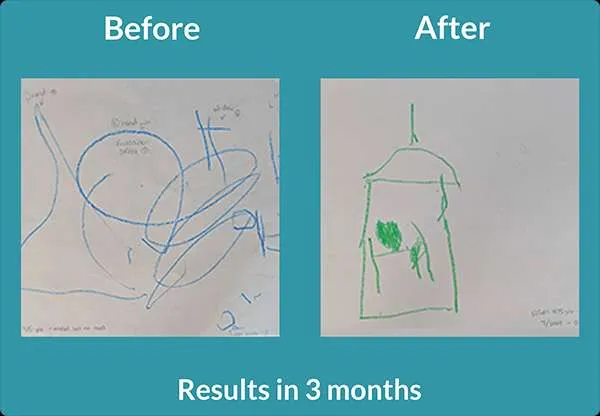 This 4-year-old struggled with daily headaches, anxiety, meltdowns, and fine-motor challenges. See how his OT used rhythmic movements and primitive reflex integration for dramatic improvements in self-regulation, sleep, focus, handwriting. And, no more headaches!
References
Andrich, P., Shihada, M. B., Vinci, M. K., Wrenhaven, S. L., & Goodman, G. D. (2018). Statistical relationships between visual skill deficits and retained primitive reflexes in children. Optometry & Visual Performance, 6(3).
Bein-Wierzbinski, W. (2001, March). Persistent primitive reflexes in elementary school children. Effect on oculo-motor and visual perception [Conference session]. The 13th European Conference of Neuro-Developmental Delay in Children with Specific Learning Difficulties, Chester, UK.
Domingo-Sanz, V. A. (2024). Persistence of primitive reflexes associated with asymmetries in fixation and ocular motility values. Journal of Eye Movement Research, 17(2).
Domingo-Sanz, V. A. (2022). Inhibition of Primitive Reflexes and Its Relationship with Visual Projection in Children and Adolescents. Optometry & Visual Performance, 10(4).
Gonzalez, S. R., Ciuffreda, K., Hernandez, L. C., Escalante, J. B. (2008). The correlation between primitive reflexes and saccadic eye movements in 5th grade children with teacher-reported reading problems. Optometry and Vision Development, 39(3), 140-14.
McPhillips, M., Hepper, P., & Mulhern, G. (2000). Effects of replicating primary-reflex movements on specific reading difficulties in children: A randomised, double-blind, controlled trial. The Lancet, 355 (9203), 537-541.
Priya, S. V., Priya, T. V., Amudha, P., & Lalithambigai, C. (2021). The relationship between headache and convergence insufficiency. Panacea Journal of Medical Sciences, 11(1), 147-150.
Walhberg, T., & Ireland, D. (2005). Can replicating primary reflex movements improve reading ability? Optometry & Vision Development, 36(2).

Sonia Story, M.S. has been teaching neurodevelopmental movements since 2006.
Sonia developed the Brain and Sensory Foundations curriculum and the Foundation for Optimal Function course to provide comprehensive training in neurodevelopmental movements—combining innate rhythmic movements, play, primitive reflexes, and postural reflexes.
She earned a Bachelor's degree in biology/psychology and a Master’s degree in Movement Sciences. She is the author of The Importance of Reflex Integration and the Evidence eBook, giving the rationale and evidence basis for using neurodevelopmental movements for helping with challenges such as ADHD, Sensory Processing Disorders, anxiety, emotional dysregulation, visual skill deficits, poor social skills, gross and fine motor delays and other neurodevelopmental and behavioral disorders.
Her work is featured in numerous podcasts, summits, and conferences, and in the books Almost Autism: Recovering Children from Sensory Processing Disorder; Special Ed Mom Survival Guide; Family Health Revolution; and Same Journey, Different Paths—Stories of Auditory Processing Disorder.
Sonia’s mission is to help children and families experience the profound benefits of neurodevelopmental and integrative movements for more functional and fulfilling lives.