

Primitive Reflex Integration Case Studies
9-Year-Old No Longer Struggles with Motion Sickness
Reflex integration and rhythmic movements help with vestibular development, bedwetting, and general health
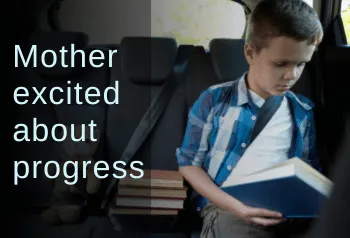
This young boy had trouble with motion sickness and bedwetting, and it was normal for him to miss 10 or more days of school every year. After consistent rhythmic movements and reflex integration he now reads in the car, has improved interoception and reduced bedwetting, and overall better health—as of late January he has not been out sick once this school year.
Submitted by KM, parent
| Before | After |
|---|---|
| Struggled with motion sickness | Car sickness significantly decreased |
| Experienced nighttime accidents several times a month (occasionally several times a week) | Nighttime accidents significantly decreased |
| Would sleep through nighttime accidents | If he does have a nighttime accident, he wakes and changes |
| Missed 10+ school days each year due to illness | Has yet to miss a day of school due to illness this school year |
My oldest son was 9 years old when we started the program. He has been working through the program about 7 months and I estimate that we have done well over 50 sessions together, but I never kept track. He spent the first 3-4 months working on the rhythmic movement foundation and he has been integrating reflexes for the last 3 months.
His primary goal and reason for wanting to do the program was to stop wetting his bed. He was able to wean himself from overnight pull-ups around the age of 7 using an alarm system, but he continued to have accidents several times a month (occasionally several times a week). He also struggles with motion sickness. He had to sit-out in gym class during a gymnastics lesson this fall after he became dizzy from forward rolls. He has asthma and in past years missed 10+ school days each year due to illness. He has also sprained his ankle several times while playing sports. While motion sickness, illness/asthma, and weak ankles were not our main targets for starting the program for him, we have seen the program address these challenges as well.
I chose to start with the rhythmic movement foundation first due to reading the Flow Chart [from the Brain and Sensory Foundations course]. Once my son was comfortable with all the passive movements and was able to do most of them on his own, I started integration of reflexes. I chose to work on the Plantar/Babinski foot reflexes, Spinal Galant reflex, and Moro reflex. To avoid overloading his system, I have him work on just one reflex per session after he’s done his rhythmic movements.
We started with the foot reflexes as the course mentioned these reflexes can make individuals more stable for addressing other reflexes next. He does not seem to struggle much with sensory issues, but he is very ticklish on his feet and has twisted his ankle several times. I focus on the games [from the Brain and Sensory Foundations course] because he is a child and I want him to enjoy our movements sessions. I quickly learned that he very much prefers playful activities, so these are what I choose to do most of the time.
I then began to alternate his sessions with work on the Spinal Galant reflex to address his bedwetting challenges. I was not surprised that he felt ticklish and uncomfortable with the stimulation and pulled away. He finds the playful integration activities to be so fun! They are easy for him to do on his own and often results in much laughter, both of which I desire to make our movement and integration sessions something pleasant. His two younger brothers often joined in with him in these spinal galant activities to be a part of the fun. I started adding in a tiny amount of isometrics about every other session. The active isometrics are too hard for him, so I chose to do the passive integration [from the Brain and Sensory Foundations course] with him.
I also chose to work on his Moro reflex. I did this because I was hoping to motivate and encourage his middle brother to work on Moro when he saw big brother doing it, too. However, I learned that Moro integration can help with asthma, motion sickness, and difficulty adapting to change, all things with which this oldest son struggles. I stimulate the Moro reflex a variety of ways. For integration I have him do the playful activities [from the Brain and Sensory Foundations course]. I recently introduced the isometric integration for Moro; he has done it for one session so far. Because he is a child I chose to start with the more playful Moro activities to encourage his enjoyment of the integration and, primarily, to motivate Moro integration for his middle brother.
I have been encouraged to see changes in my son throughout the 7 months that we have worked through the program. The first change that I noticed in my oldest son was that he complained much less about car sickness. He now spends many car rides reading or solving a Rubik’s Cube for part or all of the trip. This is something that he could NEVER do before.
I have also seen improvement in his bedwetting. Initially, we did the movements right before bed, but I noticed that his bedwetting increased dramatically. I learned from Sonia that the movements can stimulate the lymph system and when done before bed that could be causing the increased bedwetting. So we experimented with switching our sessions to the morning. It worked! His bedwetting returned to baseline and then started improving. He now rarely wets his entire bed.
Instead, the few times a month that he has an accident, he will usually just wet his pants, wake up, and change his pants in the night. Before starting movements and integration he would sleep through the wetness unaware until morning that he had wet the bed.
I have not noticed a significant change with my son’s ankle weakness since starting the program. He has complained of a sore ankle at least once this winter’s basketball season which seems typical. However, his feet seem less ticklish when I stimulate them compared to before we started integration of the foot reflexes. I have also been surprised to realize that my oldest son has yet to miss a single school day due to illness this school year. He has rarely been sick this school year, and when he has gotten sick the illnesses have been mild. I learned that Moro integration can help with asthma/allergies/the immune system, something which I had overlooked when initially learning about Moro integration. We still have a lot of work to do with reflex integration, but I am very encouraged by his progress and, more importantly, he is, too!
(Edited, emphasis added)
*Disclaimer: The activities in the Brain and Sensory Foundations curriculum make use of the natural processes of neuroplasticity and development that are innately wired in the design of human beings to promote maturity and function. These activities appear to calm, organize, and mature the neuro-sensory-motor systems just as we see in the healthy development of human infants. Individual results may vary, and we do not claim to offer a diagnosis or cure for any specific condition or disorder. The Brain and Sensory Foundations activities appear to improve overall functioning resulting in measurable improvements for a range of conditions as demonstrated in over 1800 case studies from participants.