

Primitive Reflex Integration Case Studies
Writing Legibility Improves After Reflex Integration
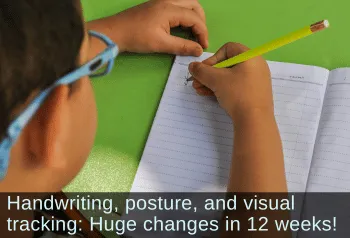
Occupational therapist sees "remarkable progress in a short period" for this 5.5-year-old student—gains in fine motor skills, midline control, visual tracking, and posture
This young boy with coordination and visual tracking issues had illegible handwriting for both Chinese characters and English letters. He was known to swap hands when crossing midline, and he demonstrated poor scissor skills and a slumped posture. 12 weeks of rhythmic movements and reflex integration from the Brain and Sensory Foundations course greatly reduced these challenges—while boosting his independence, motivation, and pride in his work.
Submitted by Cheuk Yan Wong, Occupational Therapist
| Before | After |
|---|---|
| Low confidence and required support and encouragement for writing tasks | Greater independence, motivation, and pride in writing |
| Poor posture when sitting at a table | Improved posture and body alignment |
| Inconsistent hand use and challenges crossing the midline | Established hand dominance and improved coordination when crossing the midline |
| Struggled cutting accurately with scissors | Smoother, more controlled cutting |
| Difficulty coordinating both hands for tasks | Improved coordination and use of supporting hand |
| Writting illegible due to inconsistent letter formation, sizing, and spacing | Notably better legibility |
| Fatigue when writing | Less fatigue |
Client Background
PK is a 5-year, 5-month-old boy studying in K3. He presents with significant challenges in visual-motor integration, handwriting, and fine motor coordination. Primary concerns reported by his parents and teacher include extremely poor copying skills even for basic prewriting strokes, illegible handwriting with overlapping strokes and poor sizing, and difficulty with English letters containing diagonal lines (A, K, M, N, V, W, X, Y). He has diagnosed shortsightedness and a right lazy eye, for which he wears an occlusion patch. Midline control is inconsistent, occasionally resulting in hand switching during writing. Assessment also revealed weak bilateral hand coordination, choppy scissor skills, and an inability to stabilize tools like a ruler. Notably, PK consistently leaned his torso very close to the table when writing and brought paper extremely close to his eyes during cutting tasks. He maintained a slumped, forward-flexed sitting posture during all tabletop activities.
Assessment & Clinical Reasoning
Formal and informal assessments indicated poor visual tracking, wavy line drawing, and significant spatial planning deficits, as evidenced by writing outside designated grids and gross motor plays. His difficulties with diagonal lines, midline crossing, and bilateral coordination suggested possible underlying neuromotor immaturity and unintegrated primitive reflexes. I hypothesized that retained reflexes, particularly the Asymmetrical Tonic Neck Reflex (ATNR) and Symmetrical Tonic Neck Reflex (STNR), were impacting his eye-hand coordination, bilateral integration, and ability to cross the midline smoothly—all foundational skills for handwriting and tool use.
Intervention Plan
A 12-week home based program was established, focusing on rhythmic movements and specific reflex integration activities [from the Brain and Sensory Foundations course]. We targeted the ATNR, STNR, and hand reflexes. Activities were play-based and brief (10-15 minutes daily). Biweekly 1- hour individual or group occupational therapy sessions were also conducted, in which we also had oculomotor, visual perception, and fine motor trainings followed the reflex integration activities.
Results & Observed Changes
PK and his parents diligently followed the daily movement program. The following changes were reported and observed over the 12-week period:
Before intervention:
- Consistently leaned very close to table when writing; slumped sitting posture.
- Struggled with diagonal lines in letters (A, K, W, etc.); could not manage sharp change of direction of lines; writing appeared wavy with loss of directionality.
- Occasionally switched hands during writing or cutting. Choppy cutting on 2mm thin-lined circles; jagged edges.
- Weak bilateral coordination; struggled to shift paper with left hand while cutting with right.
- Wrote Chinese characters outside 2.5cm grids: overshooting was common. Noted additional and missing strokes, overlapping strokes and poor sizing.
- Slow handwriting speed.
- Failed to stabilize ruler and draw along a straight line.
- Fair confidence; required constant adult support and encouragement for handwriting tasks.
After intervention:
- Sits more upright during table tasks; reduced leaning and improved postural alignment.
- Demonstrates ability to form diagonal lines; letters like 'W' and 'M' show clearer, more defined angles. Straighter, more controlled lines
- Consistently uses right hand for writing; improved midline crossing without hand switching. Smoother cutting motion; can cut a circle with fewer jagged edges.
- Improved paper shifting; demonstrates emerging ability to turn paper with support hand.
- Writing primarily contained within 2.5cm grids; significantly less overshooting. Stroke accuracy improved, fewer omitted or extra strokes in simple words.
- Improved spatial planning: Strokes are more distinct, and sizing is more consistent.
- Similar writing speed but improved legibility and less fatigue reported.
- Can now stabilize a ruler with non-dominant hand and draw a basic line with physical guidance.
- Increased motivation and independence; initiates writing tasks with less prompting and shows pride in his work.
Summary & Therapist Reflection
PK made remarkable progress in a short period through a targeted sensorimotor integration approach. The rhythmic movements and reflex integration activities appear to have directly supported the maturation of his visual-motor system, bilateral coordination, and postural stability. His improvements in diagonal letter formation, midline control, and scissor skills were particularly striking and directly address his initial referral concerns. This case reinforces the powerful role of addressing underlying neurodevelopmental foundations to create meaningful, functional change in paediatric occupational therapy. I look forward to continuing to support PK as he builds on these new skills.
(Edited, emphasis added)
*Disclaimer: The activities in the Brain and Sensory Foundations curriculum make use of the natural processes of neuroplasticity and development that are innately wired in the design of human beings to promote maturity and function. These activities appear to calm, organize, and mature the neuro-sensory-motor systems just as we see in the healthy development of human infants. Individual results may vary, and we do not claim to offer a diagnosis or cure for any specific condition or disorder. The Brain and Sensory Foundations activities appear to improve overall functioning resulting in measurable improvements for a range of conditions as demonstrated in over 1800 case studies from participants.