

Primitive Reflex Integration Case Studies
Reading, Writing, and Regulation Improve with Reflex Integration
7-year-old can now stay seated and focus on schoolwork
This young girl with anxiety and poor academic skills struggled to remain seated, and avoided reading whenever possible. After just six weeks of rhythmic movements and reflex integration from the Brain and Sensory Foundations First Level and Second Level courses, she can sit easily for periods of time, enjoys reading aloud to family and classmates, no longer worries constantly, and showed significant improvements in reading comprehension and handwriting assessments.
Submitted by Claudia Claudel, Learning Support Teacher

| Before | After |
|---|---|
| Reading below age level; avoided reading | Reading above age level; volunteering to read |
| Slow writing with occasional backward lettering | Writing speed and confidence improved with no letter reversals |
| Spelling challenges | Notable improvement in spelling |
| Reported persistent worry | Reported feeling calm and content |
| Struggled to stay seated | Can stay seated for longer periods |
A. is a 7-year-old girl in Grade 2. Her parents had concerns about her literacy skills, handwriting, focus and attention, sitting tolerance, and emotional well-being. She was experiencing numerous episodes of severe anxiety.
During assessment, A. exhibited the following unintegrated reflexes: Tonic Labyrinthine Reflex, Asymmetrical Tonic Neck Reflex, STNR [Symmetrical Tonic Neck Reflex], Palmar and Babkin, FPR [Fear Paralysis Reflex], Spinal Galant, Head Righting, Spinal Perez, Landau, Amphibian, and Sucking.
When introduced to the RM [rhythmic movements from the Brain and Sensory Foundations course], A. couldn’t actively perform any of them. The initial sessions were focused on RMs before integrating the reflexes.
I planned the sessions as follows:
- Week 1 and 2: fully dedicated to RM
- Week 3: the stimulation of the FR and Landau reflex
- Week 4 to 6: once the Landau reflex was integrated, the focus was on the stimulation of TLR, ATNR, STNR, and Head Righting.
- Week 6: stimulation of the palmar and Babkin reflex
A. received 3 weekly interventions over 6 weeks. Being 7 years old, she had no mental resistance and was enthusiastically and fully engaged in all activities.
Here are some of the improvements I observed in assessments run 6 weeks apart: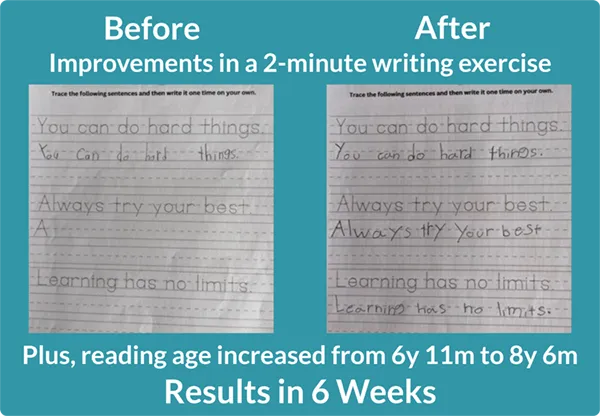
- In the Toe by Toe reading assessment, A. initially tested at a reading age of 6y 11m. Upon the second assessment, she tested at 8y 3m — a gain of 1y 4m.
- Her handwriting speed improved (see Before and After photos).
- For the Word Wasp spelling assessment, A. initially completed 5 levels, with 41 correct answers out of 50 (stopped at level 5 as too many mistakes). Upon her second assessment, she completed 10 levels, with 90 correct answers out of 100.
- Before each session, A. would evaluate where she stood on the emotional thermometer. She started at 7 out of 10, stating “I have worries, and I keep thinking about them.” Before her session 6 weeks later, her evaluation was 1 out of 10, stating, “I am calm and content.”
- For sitting tolerance, her self evaluation was 0 out of 10 (I really struggle to stay seated). Six weeks later, her self-evaluation was a 7 to 8 (I can stay seated for longer periods without any struggle).
She also completed the 5-Step Balance Process [from the Brain and Sensory Foundations course] to work on the following goal: "I can read in front of others."
A.’s parents and classroom teacher noticed a remarkable change in her attitude toward reading. From avoiding reading, she started volunteering.
I was very impressed to see quick results in this short time, and the parents were too. They didn’t expect to witness changes so fast. I had to stop the sessions with this young girl as the family was moving to another country. The most beautiful moments for me in these sessions were each time A. was pointing at the 1 on the emotional thermometer, meaning "I am calm and content."
(Edited, emphasis added)
*Disclaimer: The activities in the Brain and Sensory Foundations curriculum make use of the natural processes of neuroplasticity and development that are innately wired in the design of human beings to promote maturity and function. These activities appear to calm, organize, and mature the neuro-sensory-motor systems just as we see in the healthy development of human infants. Individual results may vary, and we do not claim to offer a diagnosis or cure for any specific condition or disorder. The Brain and Sensory Foundations activities appear to improve overall functioning resulting in measurable improvements for a range of conditions as demonstrated in over 1800 case studies from participants.