

Primitive Reflex Integration Case Studies
Stroke Patient Can Walk After Primitive Reflex Integration
Veteran occupational therapist sees “one of the most remarkable recoveries” for 86-year-old stroke survivor using primitive reflex integration from the Brain and Sensory Foundations course.
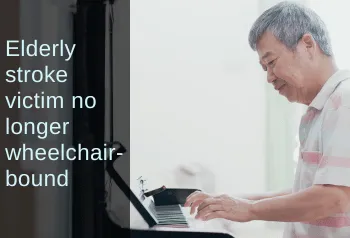
This elderly man was confined to a wheelchair after a stroke, and required full assistance for transfers and activities of daily living (ADLs). Five months of rehab—including three months of home-based occupational therapy services—had yielded few improvements. Once his OT began providing rhythmic movements and reflex integration from the Brain and Sensory Foundations course, this stroke victim experienced tremendous gains: After 2.5 months he could bend at the waist, stand with minimal help, feed himself, and walk with support. He even resumed playing the piano!
Submitted by John Maynarich, Occupational Therapist
| Before | After |
|---|---|
| Mutism with strangers | Able to speak around others |
| Wheelchair-bound; unable to walk or stand | Can ambulate with the assistance of one person for guidance and fall prevention |
| Required hoyer lift for all transfers | Requires minimal assistance from one person for transfers |
| Lost ability to play piano due to right-sided weakness | Playing the piano again |
| Maximally dependent for all ADLs | Feeding himself with his right hand; can groom himself if the supplies are laid out |
Client is an 86-year-old male who suffered a Left CVA with right hemiplegia in 2024. He also had a past history of HTN, Dementia, Hernia, CHF. He lives at home with his wife who is the primary caregiver. He was receiving home health OT, PT and speech therapy and nursing visits. Prior to stroke, he was independent with all ADLs but used a cane for ambulation. He had a 2-month hospital and rehab stay with very little improvements when discharged back to home. Patient was max/dep [maximally dependent] and wheelchair-bound at time of discharge back to home.
This individual presented with the following challenges at the time of my OT evaluation in February 2025.
- Mutism with strangers who enter the home
- Fear paralysis and tactile sensitivity
- Maximally dependent for all ADLs and requiring hoyer lift for all transfers
- Wheelchair-bound and unable to walk or stand
- Lost ability to play piano due to right-sided weakness due to hemiplegia (had trace movement). He had been a piano teacher at local college.
- Unable to feed self and groom self with dominant right hand (hemi side)
I had worked with this gentleman for approximately 3 months—starting after his discharge—prior to taking the [Brain and Sensory Foundations] Primitive Reflex Course. He showed little gains in his ability to stand, walk, talk; still not able to play the piano in those 3 months. Fortunately he was regaining some residual movement of his right UE (upper extremity) and right LE (lower extremity), but not sufficient enough to feed himself or use his right UE for feeding or other daily activities to include grooming and hygiene. He still had very little trunk control with inability to bend at waist while in the wheelchair.
Retained reflexes identified with this gentleman included the Babinski reflex right foot, STNR [Symmetrical Tonic Neck Reflex], Tonic Labyrinthine Reflex, and ATNR [Asymmetrical Tonic Neck Reflex].
My first course of action was to teach him how to breathe properly and to work on forward trunk flexion utilizing a modified TLR Isometric while in his wheelchair. Patient also noted with thoracic trunk flexion from past piano playing and he could not find neck extension. For neck extension, I guided him with TLR in extension while in seated position every treatment session. I told his wife to perform gentle rhythmic movements [from the Brain and Sensory Foundations course] daily while supine in bed to promote increased neck range of motion (ROM).
On subsequent visits, I worked on his right foot owing to retained Babinski. He could not plant his right foot firmly onto the ground when seated. Due to his stroke, he had also developed the hemiplegic pattern of his right leg going into hip/knee flexion and Plantar flexion right foot. I worked on grounding movement barefoot onto the ground and also did both the Plantar and Babinski reflex integration activities [from the Brain and Sensory Foundations course] to help integrate both of these reflexes. After several follow up sessions utilizing these approaches, the patient was finally able to ground his whole right leg onto the ground and working towards modified standing with use of standing platform. Gradually he was able to fully plant his right leg into the ground without his hip, knee and ankle going in the typical flexion hemi pattern.
Again, these activities were repeated on subsequent visits 2x a week for 10 weeks. At 5-week mark he was finally able to bend at the waist in preparation for sit-to-stands with use of platform walker. He was also able to keep his right leg grounded while standing with tactile cueing and proper leg positioning (his knee goes into external rotation). He was able to stand with overall minimal support at this point using the platform walker with arm supports.
Patient was also observed with limited neck ROM and eye tracking due to prolonged sitting and bed rest. Patent regained some neck ROM (very little) after working on his breathing pattern, trunk flexion/extension with rhythmic movements (with wife) during 2x weekly sessions, but not sufficient enough to perform a full neck rotation on both sides with right neck motion more restricted owing to his right visual neglect. It was at this point I started implementing the ATNR pattern (modified). After repeated attempts of this he was able to turn his neck in both directions up to 30 degree rotation both sides with a little more neck ROM with arm extension on his left side (non impaired side).
At the 10-week mark, patient was able to fully flex and extend at his trunk while seated. This was the first time patient was able to touch the ground from the seated position. He was also able to extend his trunk back to neutral from this flexed position. He was able to stand from sitting positioning with overall minimal assist with full hip, knee and ankle dorsiflexion on his weaker right side. “It was truly a miracle!” His wife could not believe the difference. He was also able to perform neck rotation both sides and overall good eye tracking. He was taught one of the playful integration games for ATNR [from the Brain and Sensory Foundations course].
I am also happy to report that he is now playing the piano again and feeding himself with his right hand. He can also groom himself if the supplies are laid out. He can ambulate, but needs the assistance of one person for guidance and fall prevention. His wife is now able to guide him with all transfers, ambulation and ADL care with so much more ease. This client went from maximum dependency for all ADLs and mobility/transfers to now requiring only minimal assistance with ADLs and transfers. This was a gentleman everyone gave up on due to his advanced age and cognitive impairment. His cognition has stabilized and in some regards has gotten better due to his ability to play the piano again. He now smiles and laughs and has a more positive outlook on life. His mutism went away, even with others. He was still a little sensitive to touch, but lots of it diminished.
I have to say, this client will go down in history as one of the most remarkable recoveries I have ever seen in my 30 year practice as an OT.
Additional report from John Maynarich, Occupational Therapist:
I also had another success story with a 70-year-old client with a stroke, who had pain in his right shoulder and could not even raise his arm. He was independent with ambulation so he could get on the ground. I had him do [one of the Asymmetrical Tonic Neck Reflex activities from the Brain and Sensory Foundations course] and put weight throughout his right arm. After 10 minutes of this, he was able to stand up and raise his right arm to full range of motion with zero pain. His wife had tears in her eyes and was amazed. This patient went on to have full use of his right arm for all ADLs and I had him even wash windows with his affected right side. Pretty amazing…I am a neuro specialist so I am intrigued as to why these movements work so well.
(Edited, emphasis added)
*Disclaimer: The activities in the Brain and Sensory Foundations curriculum make use of the natural processes of neuroplasticity and development that are innately wired in the design of human beings to promote maturity and function. These activities appear to calm, organize, and mature the neuro-sensory-motor systems just as we see in the healthy development of human infants. Individual results may vary, and we do not claim to offer a diagnosis or cure for any specific condition or disorder. The Brain and Sensory Foundations activities appear to improve overall functioning resulting in measurable improvements for a range of conditions as demonstrated in over 1800 case studies from participants.