

Hope for Stroke, Parkinson's, and Dementia
Reclaiming Mobility and Function with the Power of Neurodevelopmental Movements
Often we forget what our teachers have taught us. But sometimes a meaningful lesson sticks and we remember it forever. Many years ago, I received two valuable teachings regarding brain injury and Parkinson's disease that I have always remembered.
By Sonia Story, M.S.
Chances are that you know someone, or will know someone, who is struggling with the aftermath of a stroke, brain injury, or chronic neurological condition like Parkinson's disease or dementia.
One of the most difficult aspects of life with brain disorders is the deterioration of mobility. With poor or absent mobility comes the loss of functional skills along with an inability to fully participate in daily life. In fact, mobility is the biggest factor in an older person's perceived health and well-being (Anderson et al., 2007).
Is there a way to re-gain mobility and function so life becomes easier and more enjoyable?
Can we also boost cognitive function and well-being for those with stroke, and neurological disorders?
Preliminary evidence suggests the answer is YES.
In this article we explore:
- Two valuable teachings about brain injury and Parkinson's disease from Svetlana Masgutova, PhD., and Harald Blomberg, M.D., respectively.
- Remarkable stories of a stroke survivor, a Parkinson's disease patient, and an individual with brain injury who all had life-changing outcomes after receiving innate rhythmic movements and primitive reflex integration.
- Research that illuminates the importance of primitive reflexes and their association with stroke, Parkinson's disease, and dementia.
- 14 reasons why neurodevelopmental movements (NDMs) can provide exceptional help for rehabilitation in cases of brain injury and neurological disorders.
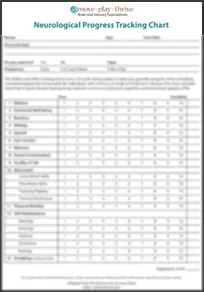
- A FREE Downloadable Resource: our Neurological Progress Tracking Chart (below) helps you document gains for individuals doing a reflex integration program. The chart can be used as a self-reporting tool which encourages and motivates individuals as they see their mobility and functional skills increasing.
Two Lessons About Brain Injury and Neurological Challenges
Lesson 1
In one of her primitive reflex integration courses, Masgutova taught that after a brain injury occurs, it is important for the injured individual to receive a movement program focused on primitive reflex integration as soon as it is safely possible. This ensures the best outcome while reducing the development of compensatory movement patterns.
Lesson 2
In his lecture and course training manual, Dr. Blomberg, talked about the use of reflex integration in cases of Parkinson's disease. He too said to intervene at the earliest point possible. He shared impressive outcomes that came from combining innate rhythmic movements with primitive and postural reflex integration activities:
"...my own experience of treating clients with Parkinson's shows that [with] the movements for integration of primitive reflexes and training of postural reflexes, motor abilities improve and the long time impairment of motor ability that usually happens in Parkinson's will not take place."
Dr. Blomberg's remarkable statement was hard for me to believe when I first heard it. But I saw mind-blowing results with my own clients, and then I heard similar stories from therapists and practitioners worldwide. Here are three examples showing tremendous outcomes for individuals who received rhythmic movements and primitive reflex integration:
3 Stories of Rehabilitation—Stroke, Parkinson's Disease, and Brain Surgery
In these stories we see how the powerful combination of innate rhythmic movements and primitive reflex integration from the Brain and Sensory Foundations course sparks tremendous transformation for these elders with neurological challenges.
1. Stroke: "One of the most remarkable recoveries I have ever seen..."
This 86-year-old stroke survivor had made only minimal progress after five months of traditional therapy. With innate rhythmic movements and primitive reflex integration from the Brain and Sensory Foundations course, he made huge improvements. Within 2.5 months, the man regained the ability to bend at the waist, stand with minimal assistance, feed himself, walk with support, and play the piano! John Maynarich, his therapist, said: "this client will go down in history as one of the most remarkable recoveries I have ever seen in my 30 year practice as an OT."
2. Parkinson's: "My whole quality of life has improved."
My first client with Parkinson's disease was Joyce, a 73-year-old who had such poor balance, she could only move via her walker or wheelchair. Within 6 weeks of starting an intensive daily rhythmic movement and primitive reflex integration program, Joyce was walking on her own, without the walker or wheelchair!
Joyce said this about her experience: "My whole quality of life has improved. I have a positive attitude and I feel more engaged with life."
3. Brain Surgery: "AMAZING progress..."
Check out these handwriting samples from a 62-year-old woman who contracted bacterial meningitis and had subsequent brain surgery to remove a large mass in the left hemisphere. Can you see the massive improvement?
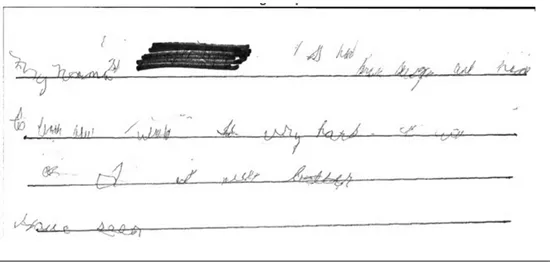
Handwriting Sample: Before
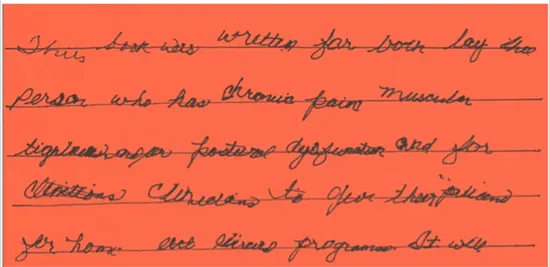
Handwriting Sample: After
This handwriting improvement came after one week of using movements from the Brain and Sensory Foundations course. Her therapist's comment: "this patient has made AMAZING progress in a few short weeks..." Thank you to Virginia Holcomb, OTR/L, CLT, for submitting these writing samples.
Read more about how neurodevelopmental movements can help elderly individuals with concerns involving stroke, Parkinson's disease, sleep, mobility, cognitive function, and pain.
Research
Primitive reflexes can re-emerge or become re-activated later in life when they should be dormant (Melillo et al., 2022; McGlown, 1990). A retained or re-activated reflex can hinder function ranging from a mild degree to a severe degree. This is reflected in the following research studies:
Chang (2001) used electrophysiological assessments to get objective, quantitative measurements of primitive reflex activity in stroke patients and to see how primitive reflex activity might affect cognition and functional skills. Chang's three findings illuminate the importance of assessment and remediation with primitive reflex integration:
- The presence of retained primitive reflexes was greater in stroke patients than in normal controls.
- Having retained primitive reflexes was associated with a decline in cognitive function.
- As the presence of retained primitive reflexes became higher, the functional independence scores were lower.
These findings are enormously significant because functional independence is a key to our quality of life.
A group of researchers found that primitive reflexes were more likely to be present in stroke survivors and in individuals with transient ischemic attacks (TIA) than in a control group; they also found that the presence of active primitive reflexes was associated with depressive disorder (Rao et al., 1999).
A 2012 study found evidence of Asymmetrical Tonic Neck Reflex (ATNR) reemergence following stroke and that this ATNR reemergence may account for the loss of independent joint control seen in stroke patients (Ellis et al., 2012).
Re-activated primitive reflexes were also shown to be higher in individuals with Parkinson's disease than for normal controls (Nuuttila et al., 2021). Sadly, the rate of Parkinson's disease in the US population appears to be increasing (Boina, 2022) and Parkinson's disease was deemed the fastest growing neurological disorder in the world today (Dorsey et al., 2018).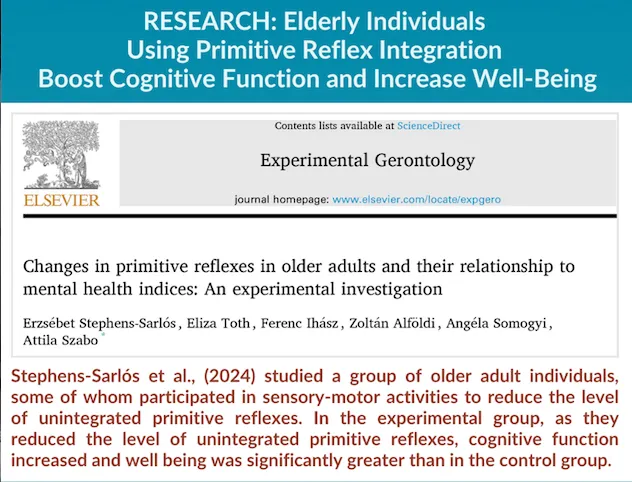
From the research above, we see that primitive reflexes can reemerge in cases of stroke and Parkinson's. Re-activated primitive reflexes are also commonly found in individuals with dementia (Altunkalem Seydi et al., 2024). And, promising research with elderly individuals showed gains in cognitive skills and well-being compared to controls after a 16-week sensory motor program for primitive reflex integration (Stephens-Sarlós et al., 2024).
Are rhythmic exercises superior for helping stroke survivors with mobility and walking? Get the answer and see more research and success stories about rhythmic movements and primitive reflexes in the elderly.
14 Reasons Why Neurodevelopmental Movements Are So Effective
Here is my list of 14 of the most common effects I see when individuals receive the innate rhythmic and reflex integration movements. This list explains why I think these neurodevelopmental movements are so effective for boosting functional skills. These movements appear to:
- Release muscle tension and increase range of motion
- Decrease pain
- Increase relaxation
- Boost mood and promote a sense of well-being
- Improve balance
- Develop rhythmic ability
- Improve gait and stamina
- Lower anxiety
- Increase cognitive skills
- Increase mobility
- Release stress
- Improve sleep
- Increase the production of myelin for improved nerve function
- Promote speech
We have the tools to help neurologically impaired individuals build the neuro-sensory-motor foundation to regain mobility and functional skills. Help spread the word in any way you can by sharing this newsletter.
Thank you for being a part of our Move Play Thrive community, and enjoy the Free Resource below.
 Get Inspired with this Free Resource
Neurological Progress Tracking Chart
We created this chart so you can track the progress of individuals with neurological challenges. Join the Brain and Sensory Foundations course and enjoy helping clients and loved ones make gains with neurodevelopmental movements.
Use this Neurological Progress Tracking Chart to get a Before and After look at areas related to neurological functioning.
This chart uses a 10-scale rating system to help you quantify progress when providing neurodevelopmental movements for individuals with neurological challenges or brain injury. This chart contains more than a dozen factors representing common concerns in physical, cognitive, and emotional quality of life. It is so inspiring to see the positive changes that come with neurodevelopmental movements that work for all ages.
References
Altunkalem Seydi, K., Kaya, D., Yavuz, I., Ontan, M. S., Dost, F. S., & Isik, A. T. (2024). Primitive reflexes and dementia in older adults: A meta‐analysis of observational and cohort studies. Psychogeriatrics, 24(3), 688–700.
Andersen, D. A., Roos, B. A., Stanziano, D. C., Gonzalez, N. M., & Signorile, J. F. (2007). Walker use, but not falls, is associated with lower physical functioning and health of residents in an assisted-living environment. Clinical interventions in aging, 2(1), 123-137.
Boina, R. (2022). Assessing the Increasing Rate of Parkinson’s Disease in the US and its Prevention Techniques. International Journal of Biotechnology, 3(1), 1-18.
Chang, C. W. (2001). Electrophysiological assessments of primitive reflexes in stroke patients. Clinical neurophysiology, 112(6), 1070-1075.
Dorsey, E. R., Sherer, T., Okun, M. S., & Bloem, B. R. (2018). The emerging evidence of the Parkinson pandemic. Journal of Parkinson’s disease, 8(s1), S3-S8.
Ellis, M. D., Drogos, J., Carmona, C., Keller, T., & Dewald, J. P. (2012). Neck rotation modulates flexion synergy torques, indicating an ipsilateral reticulospinal source for impairment in stroke. Journal of Neurophysiology, 108(11), 3096-3104. doi:10.1152/jn.01030.2011
McGlown, D. J. (1990). Developmental reflexive rehabilitation. Taylor & Francis. pp.121-122.
Melillo, R., Leisman, G., Machado, C., Machado-Ferrer, Y., Chinchilla-Acosta, M., Kamgang, S., Melillo, T. and Carmeli, E., (2022). Retained primitive reflexes and potential for intervention in autistic spectrum disorders. Frontiers in Neurology. 13, p. 922322.
Nuuttila, S., Eklund, M., Joutsa, J., Jaakkola, E., Mäkinen, E., Honkanen, E. A., ... & Kaasinen, V. (2021). Diagnostic accuracy of glabellar tap sign for Parkinson’s disease. Journal of Neural Transmission, 128(11), 1655-1661.
Rao, R., Jackson, S., & Howard, R. (1999). Primitive reflexes in cerebrovascular disease: a community study of older people with stroke and carotid stenosis. International journal of geriatric psychiatry, 14(11), 964-972.
Stephens-Sarlós, E., Toth, E., Ihász, F., Alföldi, Z., Somogyi, A., & Szabo, A. (2024). Changes in primitive reflexes in older adults and their relationship to mental health indices: An experimental investigation. Experimental Gerontology, 196, 112583.
Sonia Story, M.S. has been teaching neurodevelopmental movements since 2006.
Sonia developed the Brain and Sensory Foundations curriculum and the Foundation for Optimal Function course to provide comprehensive training in neurodevelopmental movements—combining innate rhythmic movements, play, primitive reflexes, and postural reflexes.
She earned a Bachelor's degree in biology/psychology and a Master’s degree in Movement Sciences. She is the author of The Importance of Reflex Integration and the Evidence eBook, giving the rationale and evidence basis for using neurodevelopmental movements for helping with challenges such as ADHD, Sensory Processing Disorders, anxiety, emotional dysregulation, visual skill deficits, poor social skills, gross and fine motor delays and other neurodevelopmental and behavioral disorders.
Her work is featured in numerous podcasts, summits, and conferences, and in the books Almost Autism: Recovering Children from Sensory Processing Disorder; Special Ed Mom Survival Guide; Family Health Revolution; and Same Journey, Different Paths—Stories of Auditory Processing Disorder.
Sonia’s mission is to help children and families experience the profound benefits of neurodevelopmental and integrative movements for more functional and fulfilling lives.