

Enhancing Goal Attainment with the 5-Step Balance Process
Remove Blocks to Achievement and Boost Primitive Reflex Integration
Have you ever wanted to do something but felt blocked in starting it, or unable to follow it through to the end? Accomplishing meaningful goals is easy for some, but much more intimidating for others.
By Sonia Story, M.S.
 In the Brain and Sensory Foundations First Level course I teach a 5-Step Balance process that is very useful for helping children and adults achieve their goals with less stress, more enjoyment, and greater effectiveness.
How the 5-Step Balance Works
First we identify a goal, and then we do a unique sequence of movements from the First Level course that are specifically designed to help release the stress or tension attached to the goal. Once this stress alleviated, we often see rapid improvement in functional skills. Most importantly, the individual begins to enjoy the task instead of approaching it with dread.
The 5-Step Balance Process can be helpful in many situations. It is especially good for clearing blocks in our functioning due to:
- Overwhelm
- Anxiety
- Procrastination
- Negative thoughts
- Trauma
- Feeling stuck
- Compulsive behaviors
As a result, the 5-Step Balance Process can increase performance in remarkable ways. One of the things I love about the 5-Step Balance is that it can also supercharge reflex integration at the same time. For example, for goals involving drawing or handwriting, we often add in integration of the hand reflexes to the sequence of movements in the 5-Step Balance. This boosts both the reflex integration and the goal at the same time.
In most cases, the whole process takes only 5 to 15 minutes! Even young children enjoy the 5-Step Balance, and parents and therapists have had great success making the process playful and fun. See more examples of goal achievement using the 5-Step Balance.
Not all goals are attainable in one session, however, when combined with innate rhythmic movements and primitive reflex integration this unique protocol has consistently increased progress—changing lives in powerful ways.
Origin of the 5-Step Balance
I first learned a form of the 5-Step Balance process from Brain Gym® and Touch for Health courses. In my private practice I modified the 5-Step Balance to be child-friendly and to include reflex integration. It worked so well that I decided to teach it in the Brain and Sensory Foundations, First Level course. I still use the life-changing 5-Step Balance on a regular basis for my own goals and reflex integration needs.
Success Stories
Once in a session with a 7-year-old boy, things were going well until I handed him a pencil and asked him to write a sentence. He immediately looked stressed and started to protest. Our playful mood evaporated and I was worried that we would not get it back. His mother was there, and I knew she really wanted me to help her son with handwriting. But he was refusing to participate, looking very upset, and the tension was building.
I asked him again, this time making the task easier: “Just take about ten seconds to start writing your name as best you can.” He reluctantly agreed, but it was very challenging, and his stress levels remained high. We needed to quickly diffuse the stress and bring more ease to the task for this boy. So we did a 5-Step Balance Process together.
Near the end of the session, he produced another writing sample that was markedly different from the first. He appeared much more relaxed and was willing to write more. This time—without even being aware of it—he had closed the loops on his small “a’s”, something his mother said they had been working on for months without success. When his mother pointed out the correct formation of the "a's" to him, the boy looked in surprise at the writing he had just done. He smiled and was very proud of his success—he took the paper home to show his father.
Many therapists and parents have facilitated 5-Step Balances for children with excellent results:
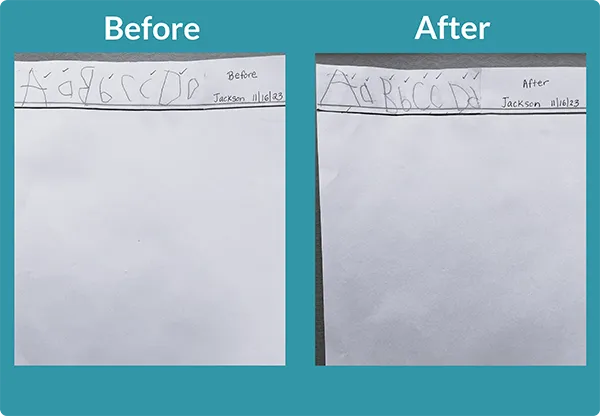 If you look at these before and after images of handwriting, you may be surprised that these changes happened in the course of a single movement session using the 5-Step Balance from the Brain and Sensory Foundations First Level course. Notice how the "after" writing is steady, with letters well-spaced, completely formed, and all facing the correct direction. Thank you to occupational therapist Emma Duryea for providing this handwriting sample.
In another example, occupational therapist Ellen Winney used the 5-Step Balance to help a 10-year-old boy who had a school assignment involving drawing a person:
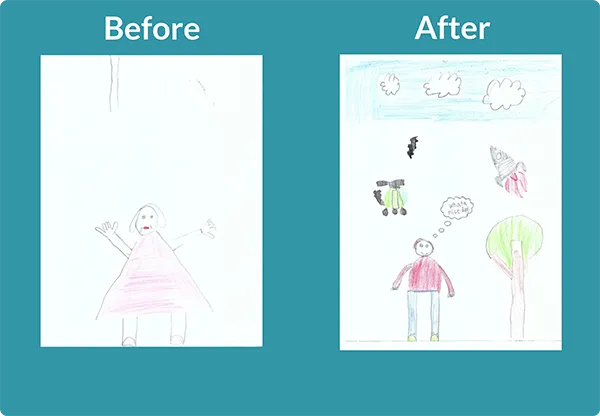 "He initially drew a picture of a girl, showing signs of discomfort (wiggling, lack of focus, disparaging remarks about his drawing). After the 5-Step Balance, he made a second drawing. This time he was visibly much more relaxed and even asked if he could continue the drawing by adding more detail. I especially love how in the second drawing, he drew a word bubble with the boy saying, 'What a nice day'. Any skepticism I had about the 5-Step [Balance] Process disappeared seeing these drawings!
You can see how, in addition to greater detail, the second drawing has more confident pencil strokes.
See more examples of transformation with the following Before and After video and case studies showing great changes in motor skills, anxiety, behavior, and self-esteem:
This 10-year-old wanted to be able to do a cartwheel with straight legs, and land in a standing position instead of a crouch. She had been working on this goal in gym class for 11 months with no improvement. Immediately after doing a 5-Step Balance, she showed significant progress and was able to land upright for the first time. Watch her inspiring Before and After video.

This 20-year-old struggled with anxiety and a long history of compulsive nail biting. After daily neurodevelopmental movements and the 5-Step Balance Process from the Brain and Sensory Foundations course, he accomplished major breakthroughs. In just 21 days, he completely stopped biting his nails. He also made striking gains in emotional regulation, focus, sensory processing, and motor skills.
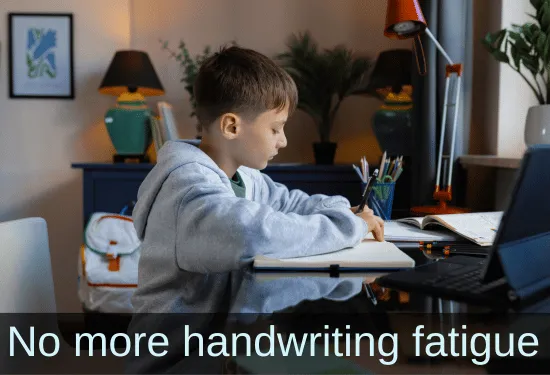
Handwriting fatigue was a real issue for this 7-year-old boy with ADHD and ASD, to the point where he frequently refused to write. He also had low self-esteem, particularly in regard to his fine motor skills. After using the 5-Step Balance process, he started to enjoy writing and became proud of his work. See the full case study.
"I’ve come to appreciate the importance of the 5-Step Balance Process. It stood out to me as a powerful tool to support students, not only in achieving specific goals but also in building their confidence and sense of agency.”
—Kim Nina Lechler, OTA
Get the tools for greatly enhancing effectiveness with goals while boosting primitive reflex integration!
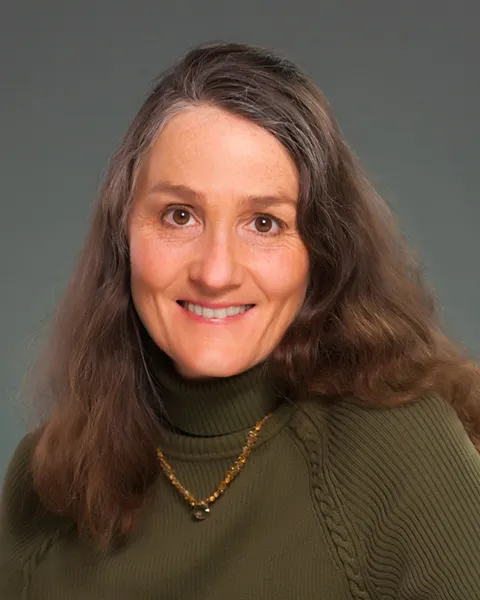
Sonia Story, M.S. has been teaching neurodevelopmental movements since 2006.
Sonia developed the Brain and Sensory Foundations curriculum and the Foundation for Optimal Function course to provide comprehensive training in neurodevelopmental movements—combining innate rhythmic movements, play, primitive reflexes, and postural reflexes.
She earned a Bachelor's degree in biology/psychology and a Master’s degree in Movement Sciences. She is the author of The Importance of Reflex Integration and the Evidence eBook, giving the rationale and evidence basis for using neurodevelopmental movements for helping with challenges such as ADHD, Sensory Processing Disorders, anxiety, emotional dysregulation, visual skill deficits, poor social skills, gross and fine motor delays and other neurodevelopmental and behavioral disorders.
Her work is featured in numerous podcasts, summits, and conferences, and in the books Almost Autism: Recovering Children from Sensory Processing Disorder; Special Ed Mom Survival Guide; Family Health Revolution; and Same Journey, Different Paths—Stories of Auditory Processing Disorder.
Sonia’s mission is to help children and families experience the profound benefits of neurodevelopmental and integrative movements for more functional and fulfilling lives.