

Eye Contact Issues
Neurodevelopmental Movements Promote Eye Contact Naturally
by Sonia Story, M.S.
Humans are social beings and we have a deep instinctive drive to gaze at faces and to visually communicate with one another, but many individuals are hindered in doing so.
 When we ask children to make eye contact, it may be very difficult for them to accomplish this without great discomfort or anxiety. For example, poor eye contact has been associated with anxiety in individuals with autism (Milne, 2023). Since eye contact is important for connection, learning, and social interactions, how can we help children to develop eye contact and social skills in the easiest and most natural way?
Because anxiety goes hand-in-hand with retained primitive reflexes (Carter, 2020; Forrest, 2002), when we address these reflexes using neurodevelopmental movements we often see substantial reductions in anxiety. By building the neuro-sensory-motor foundation, i.e. balance, motor control, brain connectivity, attention, visual motor skills, and sensory processing maturity, the nervous system becomes calm—making it possible for a child to relax more readily, make eye contact, and naturally participate in social interactions.
See over a dozen case studies from students of the Brain and Sensory Foundations course showing how better eye contact and social skills can blossom with neurodevelopmental movements.
For those who say: "These are just anecdotal stories," I would contend that case studies do count as evidence—especially when there are multiples pointing to the same phenomena. Peer reviewed research has an important role, but it is also vital to remember that human observation and clinical reasoning are valid forms of evidence too. They are less structured than randomized controlled trials (RTCs), but still highly reliable (Toews et al., 2024). These case studies were all reported by observers who were independent of one another, and the commonalities are striking.
Here's my biggest take away:
When we use neurodevelopmental movements to calm and mature the neuro-sensory-motor systems, problematic behaviors diminish and appropriate social skills emerge naturally—without having to teach these skills.
Check out these touching stories of transformation about improved eye contact and positive social interactions:
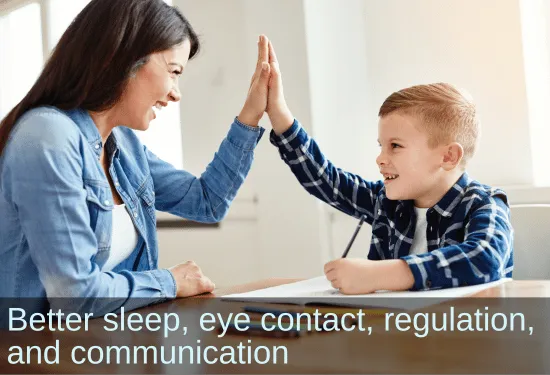 After four months of rhythmic movements and reflex integration, this 5-year-old with autism and ADHD had better sleep, communication, regulation, motor skills, and family participation. Discover how his OT got him there!
 This 6-year-old boy showed dramatic improvement in eye contact and confidence after rhythmic movements and reflex integration. Read the full case study to find out about all gains he made.
Rhythmic movements helped this young boy to improve eye contact, reduce stimming, and increase engagement. Check out the video included with this case study!
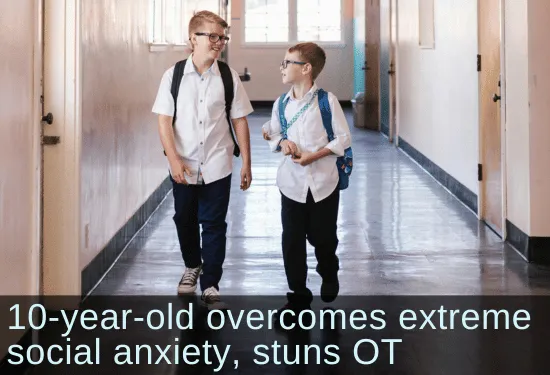
This boy with autism went from being unable to connect with his classmates and freezing when anyone tried to converse with him, to spontaneously looking at, greeting, and playing with others. See his full story.
References
Carter, T. L. (2020). An exploration of the relationship between unintegrated primitive reflexes and symptoms of anxiety in children between 10-13 years in the Western Cape Province of South Africa [Doctoral dissertation. University of South Africa].
Forrest, D. S. (2002). Prevalence of retained primitive reflexes in patients with anxiety disorders. [Doctoral Dissertation, Annexe Thesis Digitisation Project 2017 Block 16.]
Milne, D. (2023). Looking at me anxiety: Facial gaze and anxiety in Autism. [Doctoral Thesis, Charles Sturt University]. Charles Sturt University.

Sonia Story, M.S. has been teaching neurodevelopmental movements since 2006.
Sonia developed the Brain and Sensory Foundations curriculum and the Foundation for Optimal Function course to provide comprehensive training in neurodevelopmental movements—combining innate rhythmic movements, play, primitive reflexes, and postural reflexes.
She earned a Bachelor's degree in biology/psychology and a Master’s degree in Movement Sciences. She is the author of The Importance of Reflex Integration and the Evidence eBook, giving the rationale and evidence basis for using neurodevelopmental movements for helping with challenges such as ADHD, Sensory Processing Disorders, anxiety, emotional dysregulation, visual skill deficits, poor social skills, gross and fine motor delays and other neurodevelopmental and behavioral disorders.
Her work is featured in numerous podcasts, summits, and conferences, and in the books Almost Autism: Recovering Children from Sensory Processing Disorder; Special Ed Mom Survival Guide; Family Health Revolution; and Same Journey, Different Paths—Stories of Auditory Processing Disorder.
Sonia’s mission is to help children and families experience the profound benefits of neurodevelopmental and integrative movements for more functional and fulfilling lives.