

Primitive Reflex Integration Case Studies
Writing Is More Comfortable and Accurate with Reflex Integration
After 8 sessions, girl shows notable improvements in pencil grasp, letter sizing and spacing, and reading
This student had poor handwriting and fine motor skills, including difficulty with correctly sizing, spacing, and aligning letters on the page. After just eight sessions of rhythmic movements and reflex integration from the Brain and Sensory Foundations course, her handwriting improved greatly. She also demonstrated better drawing skills and ability to read aloud in front of others.
Submitted by M.O., FALCON Trainer (Educator)
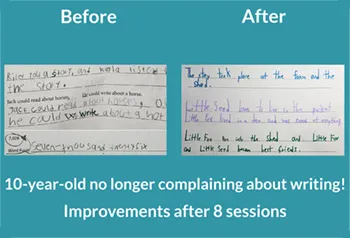
| Before | After |
|---|---|
| Struggled with handwriting, which was very disorganized, with inconsistent letter sizes and poor alignment on the page | Handwriting is much neater and more organized |
| Did not enjoy school work that required a lot of writing | No longer complains about writing assignments |
| Although a good reader, when reading aloud in front of others, her pace was slow and lacking confidence | Reading aloud now smoother and clearer |
Ruth is 10 years old. She was struggling with handwriting and did not enjoy school work that required a lot of writing. Her handwriting was very disorganized, with inconsistent letter sizes and poor alignment on the page. Another challenge for her was reading aloud in front of teachers or classmates. Although she is a good reader, when reading aloud in front of others, her pace becomes slower and less confident.
I decided to focus on Rhythmic Movements 1, 2, 3, and 4, as well as hand reflex exercises [from the Brain and Sensory Foundations course].
After eight 30-minute sessions, Ruth showed significant improvement. When she focuses, her handwriting is much neater and more organized. She no longer complains about writing assignments, and as an added benefit, she has noticed improvements in her drawing and coloring skills as well.
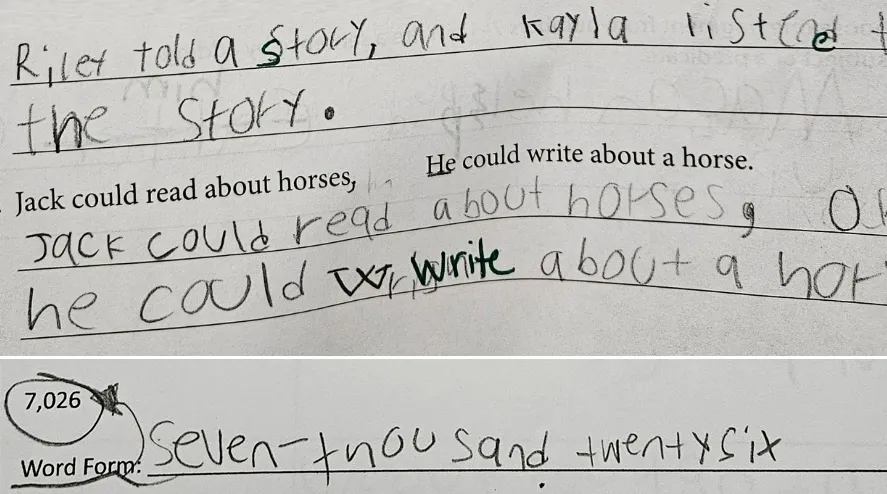
Before
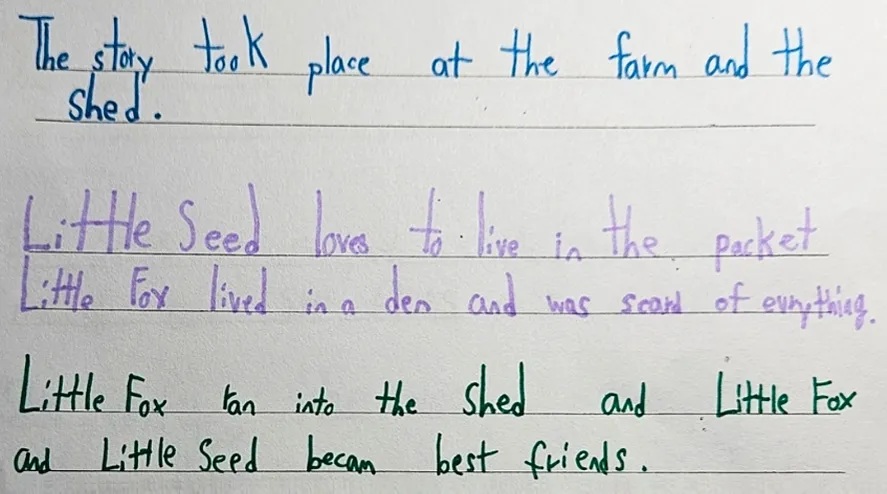
After
I believe focusing on rhythmic movements and hand reflex exercises is ideal for Ruth. I noticed that one of the hand reflex integration activities was very challenging for Ruth at first, but over time she mastered it, and she is now doing great. The way she holds her pencil now is more correct and her hand and arm seems more relaxed while writing.
My plan moving forward is to continue incorporating more hand reflex integration activities. I would also like to continue the FPR [Fear Paralysis Reflex] and Moro reflex exercises [from the Brain and Sensory Foundations course]. I believe these will be very helpful in building her confidence and helping her overcome her fears, especially when reading aloud.
We did a 5-Step Balance process from the course around her goal to read smoothly in front of teachers or classmates, incorporating the FPR and Moro. Afterwards, Ruth reported feeling less nervous, and her reading became smoother and clearer after session four. She was able to read aloud for two minutes in front of other trainers. Additionally, her teacher reported to her mother that noticeable improvements in Ruth’s reading performance were observed in class.
(Edited, emphasis added)
*Disclaimer: The activities in the Brain and Sensory Foundations curriculum make use of the natural processes of neuroplasticity and development that are innately wired in the design of human beings to promote maturity and function. These activities appear to calm, organize, and mature the neuro-sensory-motor systems just as we see in the healthy development of human infants. Individual results may vary, and we do not claim to offer a diagnosis or cure for any specific condition or disorder. The Brain and Sensory Foundations activities appear to improve overall functioning resulting in measurable improvements for a range of conditions as demonstrated in over 1800 case studies from participants.