

Doctor's #1 Solution for ADHD
Addressing ADHD Through Neurodevelopmental Movements
Would you agree that—despite decades of research into symptoms and causes—ADHD is still widespread in both children and adults? Are you interested in lasting solutions for the sensory issues, anxiety, learning, and behavioral challenges that commonly accompany ADHD?
By Sonia Story, M.S.

While numerous medications and coping strategies have been created to help with ADHD symptoms, the underlying challenges associated with ADHD remain. When we examine the deeper nature of ADHD, it reveals how this condition can be alleviated (rather than just managed) in ways that are healthy, positive, and truly effective.
3 Key Insights about ADHD, plus Dr. Blomberg's ADHD Chart
This newsletter contains 3 Key Insights for understanding and addressing ADHD. Is there a solution for reducing or overcoming ADHD symptoms that is reliable, supported by research, and helpful to promote functional skills? Read on and decide for yourself.
Key Insight 1—Doctor's Solution for ADHD
Many parents, as well as adults with ADHD, have not been informed that alternatives to medication exist, or they may have tried various interventions without success. Harald Blomberg, M.D., a psychiatrist and my first teacher in innate rhythmic movements (Rhythmic Movement Training), taught that drugs for ADHD have detrimental side effects, and follow up studies show there are no long-term benefits to drug use for ADHD (Blomberg & Dempsey, 2011). For these reasons, Dr. Blomberg was generally opposed to using medication for ADHD. Instead, he emphasized the importance of regularly engaging in innate rhythmic movements and primitive reflex integration, along with nutritional support. Dr. Blomberg developed a chart with a breakdown of his conclusions about why neurodevelopmental movements are a safer and more effective treatment for ADHD symptoms than central stimulant medications. Below you can get access to Dr. Blomberg's chart with many talking points for those seeking alternatives.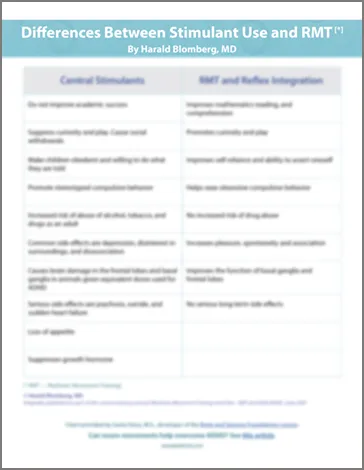 Chart comparing the use of central stimulants and neurodevelopmental movements to address ADHD.
Key Insight 2—ADHD is a Neurodevelopmental Disorder
During my first training course with Dr. Blomberg in 2007, he pointed out that ADHD is nearly always developmental in nature—that is, a lack of progress in the early development of a child accounts for ADHD behaviors later on. Dr. Blomberg explained that the typical features of ADHD—distractibility, impulsive behaviors, and hyperactivity—are similar to the characteristic behavior of normal healthy toddlers. According to Dr. Blomberg, most children with ADHD behaviors were not able to fully mature the neuro-sensory-motor systems in infancy, and this delayed maturation turns up later in childhood as ADHD behaviors. It is not a lack of intelligence, but an immaturity of the parts of the brain that govern focus, impulse control, and executive functioning.
Dr. Blomberg felt that the main reason for this delay was an inadequate amount of innate infant movements during early development which leaves the brain, body, and sensory systems less mature. Dr. Blomberg's view is supported by a body of ADHD research and by his decades of work with children. Dr. Blomberg regularly found that children were able to overcome ADHD symptoms after consistently engaging in a neurodevelopmental movement program using innate rhythmic movements and primitive reflex integration. The movements work by generating more complete development to address what was missed in early life. You can see research and more information about Dr. Blomberg's developmental perspective of ADHD in the article called: "Overcoming ADHD Symptoms with Reflex Integration."
Here is the rationale that connects research studies* and helps us understand Dr. Blomberg's successful track record of helping children overcome ADHD symptoms:
Retained primitive reflexes are a sign of brain and nervous system immaturity and neurodevelopmental delay
- ADHD is a neurodevelopmental disorder
- ADHD is characterized by a delayed maturation of the brain
- ADHD is associated with retained primitive reflexes
- ADHD is associated with a lack of rhythmic ability
- Innate rhythmic movements help to mature and integrate retained primitive reflexes
- Researchers found that using innate rhythmic movements along with balance and whole-body coordination activities helped to integrate primitive reflexes and reduce ADHD behaviors in children with ADHD (Hirose et al., 2025).
Research and case study evidence confirm the improvements Dr. Blomberg saw decades ago for children with ADHD.
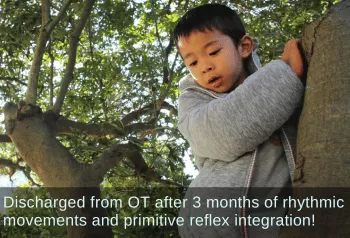
Neurodevelopmental Movements Reduce ADHD Symptoms
Attention issues and aggressive outbursts were the norm for this 6-year-old boy until he received innate rhythmic movements and primitive reflex integration. Read how his behavior completely changed in just three months.

Reflex Integration Improves Coordination, Calm, and Social Confidence
This 13-year-old girl struggled with ADHD, headaches, poor coordination, and social anxiety. When her PT provided neurodevelopmental movements, profound changes quickly occurred. Read the full case study to see all areas of progress.

ADHD Turnaround: From Struggles to Thriving Student
This 7-year-old boy's OT used neurodevelopmental movements to successfully help him develop better regulation, focus, sleep, handwriting, and confidence with socializing and schoolwork. See the complete case study.
Key Insight 3—ADHD and Co-occurring Conditions
In the last few years, I have been researching conditions that commonly co-occur with ADHD (also called "comorbidities"). One of the most striking things about these co-occurring conditions is that, like ADHD itself, they are all associated with retained primitive reflexes!
Here is a list of conditions that co-occur with ADHD. Get more information by following the individual links:
- Anxiety
- Sensory Processing Disorders (SPD)
- Hyperactivity
- Autism
- Balance deficits
- Gross motor and fine motor deficits
- Poor rhythmic ability
- Emotional and behavioral challenges
- Speech challenges
- Learning challenges
One Solution Brings Global Improvements
By giving neurodevelopmental movements to help with ADHD symptoms, we see wide-ranging improvements in functional skills. This is because innate rhythmic movements and primitive reflex integration activities also address the conditions that co-occur with ADHD! The global gains in functioning can be explained by the power of these innate movements to inherently boost brain, body, and sensory development. We have a wonderful gift in these neurodevelopmental movements to effectively address ADHD symptoms and co-occurring conditions at the same time.
Summary: ADHD is considered a neurodevelopmental disorder. Using neurodevelopmental movements to organize and develop the neuro-sensory-motor systems is effective for turning around ADHD symptoms in a deep, long-lasting way. There is no nutrient or drug that can do the work to drive development and maturity of the brain, body, and sensory systems—this is the work accomplished by the innate rhythmic and reflex movements. This explains why neurodevelopmental movements are Dr. Blomberg's top choice for helping children with ADHD. See case study examples of neurodevelopmental movements in action for helping children to turnaround their ADHD symptoms in life-changing ways!
Thank you for reading these 3 Key Insights! be sure to get your copy of Dr. Blomberg's ADHD Chart, and please share this information with friends and colleagues.
References
Blomberg, H., & Dempsey, M. (2011). Movements that heal: Rhythmic Movement Training and primitive reflex integration. Book Pal
Hirose, N., Tashiro, Y., & Takasaki, T. (2025). Effects of a 12-Week Exercise Intervention on Primitive Reflex Retention and Social Development in Children with ASD and ADHD. Children, 12(8), 987.

Sonia Story, M.S. has been teaching neurodevelopmental movements since 2006.
Sonia developed the Brain and Sensory Foundations program to provide comprehensive training in neurodevelopmental movements—combining innate rhythmic movements, play, primitive reflexes, and postural reflexes.
She earned a Bachelor's degree in biology/psychology and a Master’s degree in Movement Sciences. She is the author of The Importance of Reflex Integration and the Evidence eBook, giving the rationale and evidence basis for using neurodevelopmental movements for helping with challenges such as ADHD, Sensory Processing Disorders, anxiety, emotional dysregulation, visual skill deficits, poor social skills, gross and fine motor delays and other neurodevelopmental and behavioral disorders.
Her work is featured in numerous podcasts, summits, and conferences, and in the books Almost Autism: Recovering Children from Sensory Processing Disorder; Special Ed Mom Survival Guide; Family Health Revolution; and Same Journey, Different Paths—Stories of Auditory Processing Disorder.
Sonia’s mission is to help children and families experience the profound benefits of neurodevelopmental and integrative movements for more functional and fulfilling lives.