

Why Tickling is NOT Funny
And What to Do Instead That Is MUCH Better
When my children were young, I would occasionally tickle them but I felt uncomfortable with it, even when our youngest child would ask for it. Once I learned more about why tickling is problematic, I stopped tickling completely—and did something else that fostered true joy and connection.
By Sonia Story, M.S.
In this article, I explore:
- 3 reasons why I always advise against tickling
- What to do instead of tickling
- Another action, similar to tickling, that we should never do with friends, family, or co-workers
3 reasons why I always advise against tickling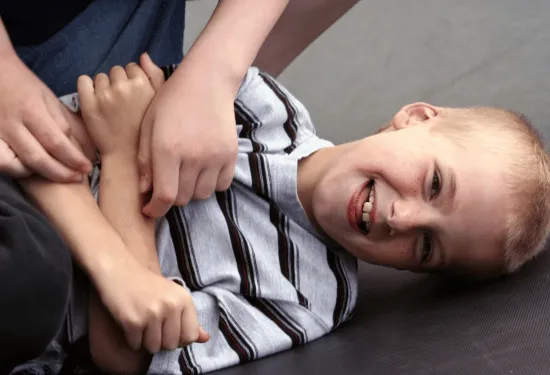
I used to think I was uncomfortable with tickling because of my own bad experiences with it as a child. I was pinned down by my brother and tickled in a "game" of "tickle torture" that he thought was funny. It was never a fun experience for me.
As a parent, I learned that my concerns about tickling were warranted, and my feelings were not just about my own bad experiences in the past. Even though tickling appears to be playful and fun, here are 3 things I became aware of about tickling and why I never recommend it:
1. Breaking trust
When we reach out to touch a child for any reason, we want them to trust that our hands will always be gentle, loving, safe, and appropriate. We may have loving intentions when we tickle, but think about it—the natural reaction of a child after being tickled is to flinch or squirm away from your touch in anticipation of being tickled again. This actually happened to me with my daughter—even when I was not reaching in to tickle, she thought I was about to tickle her and she flinched away. Seeing this first-hand I realized that her trust in my touch was being undermined, even if it was not consciously happening.
2. Unhealthy power dynamic
Tickling involves an unequal power dynamic. Let's assume that the tickler is the parent and the child is the one being tickled. The child is not in control of when to start or stop the tickling. Though the child may yell "stop," it is the parent who actually determines when to stop. Even if we are being respectful and we stop when the child says to stop, tickling involves an unhealthy dominance that can work against us as we are building our relationships with our children.
3. Pain receptors and stress hormones
Researchers have determined that tickling stimulates both the touch receptors and the pain receptors on the skin (Harris, 1999). So even though laughter often erupts with tickling, the laughter is not a joyful laughter—rather, it is most likely a nervous system response of fight-or-flight (Harris, 1999) that stimulates stress hormones like adrenaline. There are better ways to have fun together that do not increase stress.
What to do instead of tickling—and what to do if a child asks to be tickled
While attending a Playshop taught by play expert O. Fred Donaldson, he advised never to tickle children while playing. When I asked him: "What do we do if our child is asking to be tickled?" he gave an answer that made so much sense to me:
I believe that when children ask to be tickled, what they really want is intensity of playful engagement with us. So it is best not to tickle, even if children are asking for it. Instead, play with them robustly—that will satisfy their need for intense engagement and joyful laughter with you, but without the negative effects of the tickling (paraphrased).
You can learn more about what O. Fred Donaldson calls "Original Play" in his beautiful book Playing By Heart: The Vision and Practice of Belonging, and also in the Brain and Sensory Foundations First Level course. In addition to Original Play, this training provides instruction on how to calm the nervous system with rhythmic movements and reflex integration.
In summary: Tickling is problematic because it can unconsciously break trust, promote unhealthy power dynamics, and increase stress while stimulating a fight-or-flight response in the nervous system. In short it is best to say No to tickling and Yes to play.
Another action we should always avoid
Along with tickling, there are similar dynamics involved with the practice of intentionally startling someone. Sometimes children and adults think it is funny to sneak up on a sensitive individual when they are unaware and suddenly touch them, or jump out and startle them with a loud noise. Don’t do this! Though it is meant to be a joke and may seem funny, it never feels good for the one on the receiving end. A strong startle response is a stressful fight-or-flight reaction and is most likely an expression of an unintegrated (retained) Moro reflex. The Moro reflex should only be active and expressed in early infancy. Ideally this primitive survival reflex—a normal reaction in infancy that trains the nervous system’s fight-or-flight response—becomes dormant after the second month after birth. In the Brain and Sensory Foundations course we approach Moro in a unique way. Because this reflex can be activated by any of the main senses, not just vestibular, we include assessment methods for each of the senses. The course also provides numerous integration activities that are child-friendly and adaptable.
I recently spoke to a physical therapist who is working to integrate her own active startle response (Moro reflex), which was likely due to an injury she sustained in early childhood. Her poignant words are important for all of us to think about and talk about:
"I find it really sad that we live in a culture where it's socially acceptable to bully other adults in the workplace who have a startle reflex. I've been targeted and have seen other co-workers in the past targeted as a source of entertainment and unfairly labeled as "uptight" and repeatedly told that they need to "just relax!" How many adults are out there who need validation and help with this?" —Laura, P.T.
Like tickling, intentionally startling others creates stress and perpetuates an unequal power divide. So we need to start conversations about these topics, raise awareness, and give support to individuals who are more sensitive.
Comments from readers about their experiences with tickling:
"I was tickled terribly as a child by my half brother who was 7 years older than me. He didn't live with us, but visited on weekends. He always wanted his way. When I got Rolfed (the full 10 sessions) in my early thirties in Japan, the sensitivity I was holding in my body was finally released. The man Rolfing me asked me if I had ever been tickled in a particular spot and my emotions flooded out...I can totally understand how tickling is not good. I have very strong feelings about it. It was quite interesting how you explained it because I haven't really thought about it before!"
"I have worked with many children with various challenges, and many very young ones. Another thing that I have become sadly aware of is that tickling is sometimes used by predators of children to break down touch barriers, for grooming. It is one of the signs that makes me suspicious of possible danger of sexual abuse for the child, depending on the circumstances."
"As a child, my stepfather would tickle me past the point of begging him to stop, to screaming, until I would go completely still and quiet. I have NEVER tickled any of my children."
"Wow. This "tickle" article really struck a nerve with me! As a child, almost every time my family would travel to visit my relatives, I was subjected to "tickle torture" from my two male cousins (both 4 years older than I). As I had no control over it, I would laugh and laugh (of course, automatic response) and this likely gave the erroneous feedback that I was enjoying this play (or bullying) but it truly was torture and I would be so mad during and afterwards. I recall really wanting them to like me and let me play with them so I didn't "tell on them" to the adults (and back in the '70s the adults probably would have just scoffed at me anyway). Looking back now, it is a sad memory for me as I recall how much cortisol must have been streaming through my body as I was put into fight or flight all while my cousins enjoyed the experience. Thanks for putting the word out there on this one!! I hope lots of people get your message."
References
Harris, C. R. (1999). The mystery of ticklish laughter. American Scientist, 87(4), 344.

Sonia Story, M.S. has been teaching neurodevelopmental movements since 2006.
Sonia developed the Brain and Sensory Foundations curriculum and the Foundation for Optimal Function course to provide comprehensive training in neurodevelopmental movements—combining innate rhythmic movements, play, primitive reflexes, and postural reflexes.
She earned a Bachelor's degree in biology/psychology and a Master’s degree in Movement Sciences. She is the author of The Importance of Reflex Integration and the Evidence eBook, giving the rationale and evidence basis for using neurodevelopmental movements for helping with challenges such as ADHD, Sensory Processing Disorders, anxiety, emotional dysregulation, visual skill deficits, poor social skills, gross and fine motor delays and other neurodevelopmental and behavioral disorders.
Her work is featured in numerous podcasts, summits, and conferences, and in the books Almost Autism: Recovering Children from Sensory Processing Disorder; Special Ed Mom Survival Guide; Family Health Revolution; and Same Journey, Different Paths—Stories of Auditory Processing Disorder.
Sonia’s mission is to help children and families experience the profound benefits of neurodevelopmental and integrative movements for more functional and fulfilling lives.