

Kids Do NOT Grow Out of Deficits
Research Shows Most Children Have Retained Primitive Reflexes That Are Linked to Persistent Challenges
Recent research revealed that a large majority of children—86 to 100 percent—exhibited retained primitive reflexes and associated motor deficits. For kids who struggle with motor deficits in early life, research also shows we cannot assume they will “grow out” of these challenges without intervention.
By Sonia Story, M.S.
Why are so many of today’s children struggling with daily life, social skills, and academics? It is likely that retained primitive reflexes and associated early infant motor deficits are among the biggest factors hindering a child’s later ability to function well.
Research shows that motor deficits in early infancy:
- Can be carried over from infancy into childhood (Piek et al., 2010).
- Are appearing in the vast majority of today’s children (Rathod et al., 2024; León-Bravo et al., 2023; Goddard Blythe, et al., 2022; Feldhacker et al., 2021).
- Are associated with physical, social-emotional, behavioral, and cognitive challenges (see research) and these gaps in functioning are not likely to go away over time as the child matures (Adamović et al., 2022; Salavati et al., 2021; Grzywniak, 2016).
- Can be remedied with sensory-motor programs that mature the primitive reflexes and help children catch up to their peers (Niklasson et al., 2017).
Why are motor skills in early infancy so important? Because they often determine what happens when a child reaches school age. Children with more developed gross motor skills in early infancy show better cognitive skills when they reach the ages of 6 to 11, especially in the areas of working memory and processing speed (Piek et al., 2008). The converse is also true. Poor motor skills in infancy lead to worse outcomes in motor and cognitive skills at school age (Salavati et al., 2021; Piek et al., 2008).
A worldwide crisis in children's development
According to recent research, the vast majority of children are showing motor deficits in the form of retained primitive reflexes that should have matured and become dormant in infancy. Taken together, the following studies signify a worldwide crisis in our children’s development:
- Rathod et al. (2024) found that for a group of 107 children between 4 and 6 years old, 86% had retained primitive reflexes.
- In a study of 120 apparently healthy children (ages 3-8) without neurological disability in Córdoba, Spain, 89.5% had retained primitive reflexes (León-Bravo et al., 2023).
- Out of 120 school children in the UK (ages 4-5), only three had no signs of motor abnormality (Goddard Blythe, et al., 2022).
- In a study of 53 children (5-7 years old), 100% had at least one retained primitive reflex (Feldhacker et al., 2021).
Persistent challenges are linked to retained primitive reflexes
A large body of research shows that retained primitive reflexes (RPR) are associated with physical, social-emotional, and cognitive challenges. Retained primitive reflexes and their associated motor deficits can negatively affect the development of the brain, body, and sensory systems and ultimately our children’s well being. In one important example, Piek et al. (2010) found that children with RPR and motor deficits in infancy and early childhood were far more likely to show anxious and depressive symptoms at 6 to 12 years of age than children without motor deficits in infancy.
 Konicarova et al. (2013) described retained (persisting) primitive reflexes (RPR) as “one of the most important postnatal developmental deficits” (p. 1457) because of their influence on higher level motor abilities and cognition, and because past studies showed RPR were associated with neuropsychiatric disorders. Konicarova et al. (2013), examined RPR in school-age girls (aged 8-11) diagnosed with ADHD. The study examined the extent to which two RPR were present in 35 medication-naïve girls with ADHD, compared to an age-matched control group of 30 girls without ADHD. The parents of girls in both groups were asked to complete a standard questionnaire to assess ADHD symptoms. Data analysis revealed that RPR were closely linked to ADHD symptoms including anxiety, impulsivity-hyperactivity, learning problems, and perfectionism. Interestingly, the impulsivity-hyperactivity was related to muscle tension that Konicarova et al. (2013) reasoned might lead to problems sustaining attention. This was a strong study because the researchers used a control group and chose subjects who had never received medication for their ADHD.
Can children grow out of deficits?
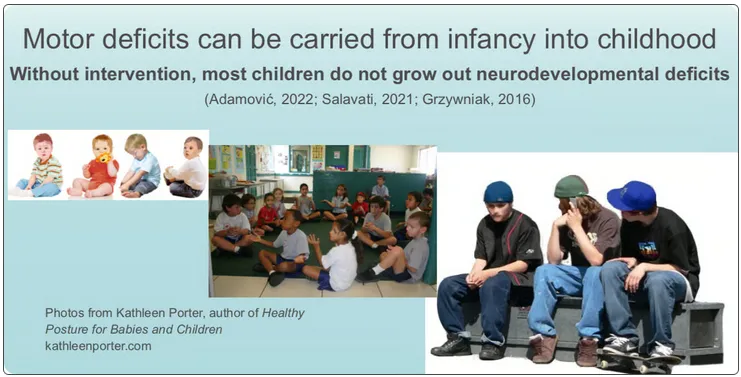 We all hope that our children will grow out of their challenges and struggles. It is natural to think that time and maturation can make our children’s challenges go away. But research indicates this rarely happens. Instead, gaps in functioning and delays in academic ability typically get worse over time (Adamović et al., 2022; Salavati et al., 2021; Grzywniak, 2016). For example, Adamović et al. (2022) found that healthy babies with normal development varied in the maturity of their head control (head righting reflexes) a few days after birth. Those with absent or incomplete head control reflexes had poorer balance at 5 years of age and less speech and language ability. In another example, Salavati et al. (2021) used video assessment and scoring of various movements in infants born preterm. The children who had a history of poor movement in infancy did not tend to grow out of associated motor and cognitive deficits by the age of 8. The researchers found that the functioning of the preterm-born children at 8 years old was impaired compared to their peers, and that the gap in motor and cognitive skills was wider at eight years than in a previous study following the same children at 2 and 4 years old (Salavati et al., 2021).
Some children may appear to eventually catch up without help. This is usually because as children get older, they gradually (often unconsciously) get more skilled at compensating for underlying neuro-sensory-motor deficits. But compensation comes with added stress and effort. And as the demands of daily life and schooling increase, academic and emotional challenges often intensify because the neuro-sensory-motor foundations have not been adequately developed (Goddard Blythe, 2017).
Can children catch up with intervention?
Sensory-motor interventions can help children catch up to their peers according to Niklasson et al. (2017), who studied children diagnosed with developmental coordination disorder (DCD) that had not received any treatment. Their hypothesis stated that the DCD children (aged 5-13 years) could reach the level of their normally developing peers on sensorimotor skills tests after undergoing sensorimotor treatment. Part of the initial assessment included scores for retained primitive reflexes (RPR) among other motor skills tests. Additionally, primitive reflex movements were used as a part of the therapeutic treatment plan for the children with DCD. This research supported the idea that RPR were associated with DCD and that the use of movements designed to integrate primitive reflexes could help developmentally delayed children to catch up to the level of functioning of their non-delayed peers. Strengths of this study included the use of comprehensive, individualized movement programs lasting 36 months, with post-tests done three months after the end of the treatment. The study design showed that maturity alone did not account for the observed changes. The treated children also improved in behavioral measures according to before and after surveys from parents and teachers.
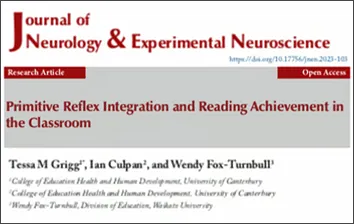
When we integrate primitive reflexes we see measurable improvements in self-regulation, along with improvements in sensory, motor, cognitive, and social-emotional functioning. We even have research showing that 5 minutes a day of neurodevelopmental movements in the form of innate rhythmic movements makes a difference and increases reading scores (Grigg et al., 2023).
We can alleviate a lot of suffering and damage to a child’s self-esteem by developing a good foundation for physical, social-emotional, and cognitive functions. Not only can sensory-motor intervention help, it is often the only thing that helps. McPhillips et al. (2000) investigated whether retained primitive reflexes (RPR) played a role in disrupting the development of reading in children with dyslexia. This study pointed to the need to go beyond cognitive approaches that may be severely limited in their ability to remediate reading challenges. Instead, McPhillips et al. (2000) showed that approaches focused on the primary (primitive) reflex system to improve motor skills could also improve reading and were warranted for children with known reading issues. They cited studies that showed children with dyslexia had concurrent balance and motor deficits. The authors concluded that it 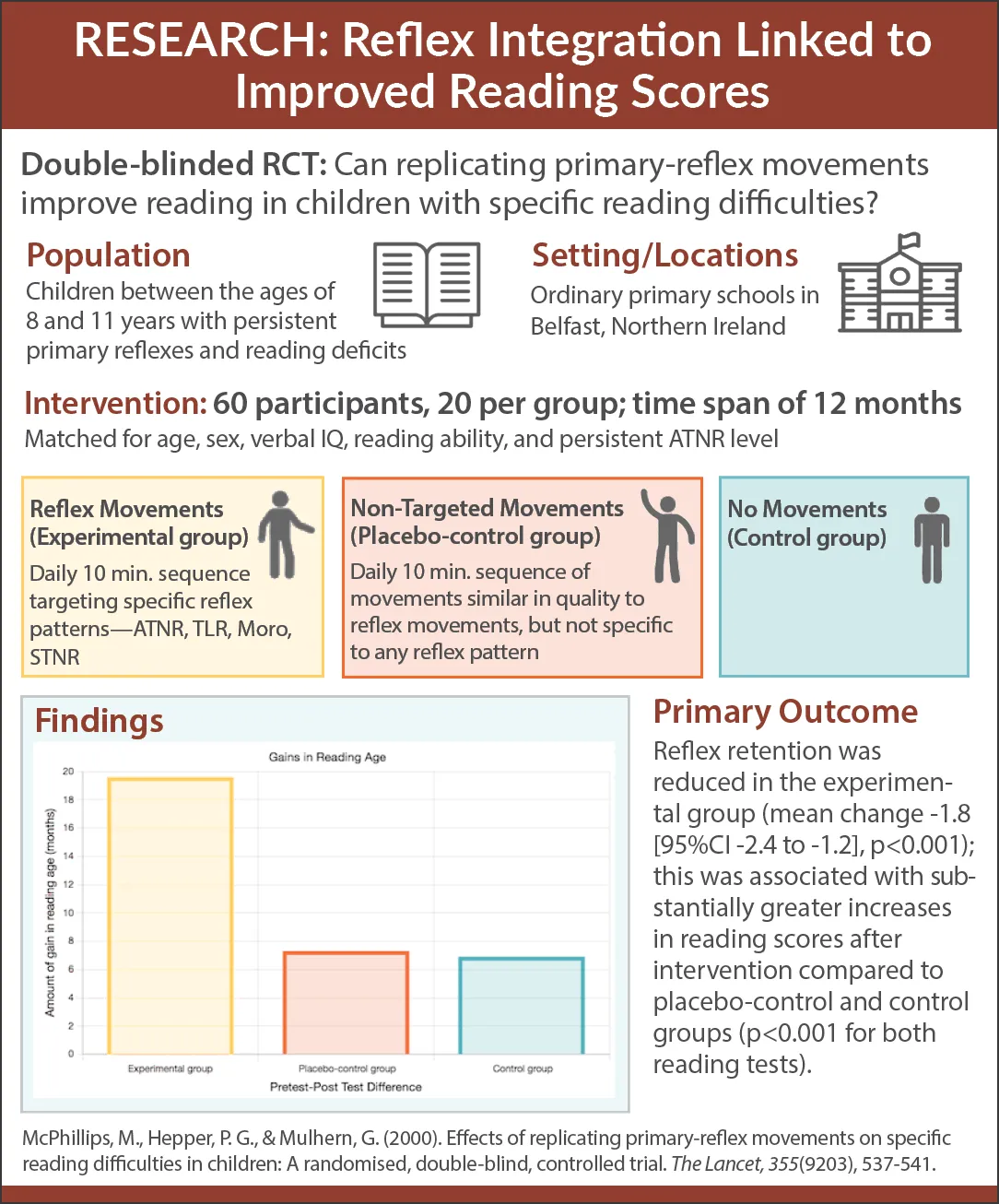 appeared likely that the primitive reflexes of infancy were critical for maturity of neurological systems that in turn affect the ability to read later in life. The study design included several strengths. First, participants were matched in terms of age, IQ, sex, spelling and reading assessments, and level of ATNR persistence. Second, there was randomized, distribution of participants into three groups: experimental, control, and placebo-control. Third, the study was double blinded. McPhillips et al. (2000) found that by repetition of stereotypical infant primitive reflex movements, they were able to inhibit the expression of ATNR in school-age children (8-11 years). As the level of ATNR persistence decreased, reading skills improved.
In another example, the balance sense is a foundational motor skill that has wide reaching implications. The ability to maintain good balance comes about in large part as a result of mature, integrated primitive reflexes. Balance ability appears to be especially foundational to our children’s academic success (Goddard Blythe, 2009) and to their well being. For example, Bart et al. (2009) found that using sensory motor activities to improve balance in anxious children was associated with a reduction of anxiety and improvements in the children’s self-esteem.
To truly enable a more complete and beneficial development—and to address neuro-sensory-motor deficits—it is important to give the brain, body, and sensory systems the very movements that drive development in the first place—the neurodevelopmental movements. Among these are:
- Primitive reflexes
- Postural reflexes
- Innate rhythmic movements
- Developmental movements
All of these neurodevelopmental movements are included in the Brain and Sensory Foundations program, along with integrative movements that release stress and enhance reflex integration.
For children who struggle with learning, attention, speech delay, anxiety, behavior challenges, sensory issues, or hyperactivity, neurodevelopmental movements are an essential intervention to help children overcome gaps in development. And, because they fuel the foundational motor skills and neuro-sensory-motor maturity, the neurodevelopmental movements are a gift we can give to our children that will serve them for life.
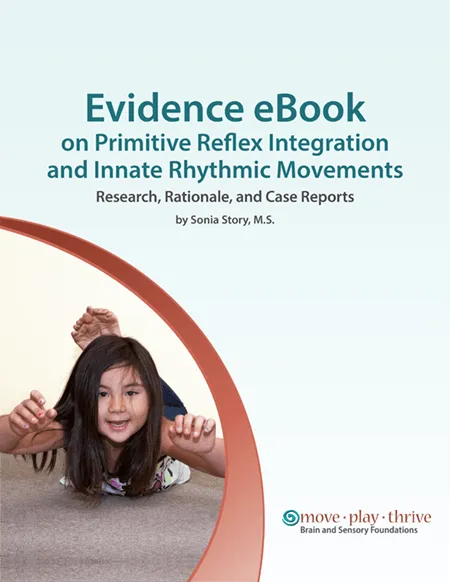
For more of the relevance, research, and rationale, plus inspiring case study summaries get the Free Evidence eBook for primitive reflex integration.
 Get Inspired with this Free Resource
Get peer-reviewed research, case reports, and a solid rationale for using infant rhythmic and reflex movements to support functional skills, learning, and self-regulation.
References
Adamović, T., Jurišić-Škevin, A., Madić, D., Sovilj, M., Jeličić, L., Maksimović, S., & Subotić, M. (2022). Head righting reflex in newborns as the predictive factor of early child development: A longitudinal study. Early Child Development and Care, 192(5), 748-760.
Feldhacker, D., Cosgrove, R., Feiten, B., Schmidt, K., & Stewart, M. (2021). Relationship between retained primitive reflexes and scholastic performance. The American Journal of Occupational Therapy, 75(S2).
Goddard Blythe, S., Duncombe, R., Preedy, P., & Gorely, T. (2022). Neuromotor readiness for school: The primitive reflex status of young children at the start and end of their first year at school in the United Kingdom. Education 3-13, 50(5), 654-667
Goddard Blythe, S. (2017). The Effects of Neuromotor Immaturity in Adults and in Adolescents. In Attention, Balance and Coordination (eds S. Goddard Blythe, L.J. Beuret, P. Blythe and V. Scaramella-Nowinski).
Goddard Blythe, S. (2009). Attention, Balance, and Coordination. The A.B.C. of Learning Success. John Wiley & Sons Ltd.
Grigg, T. M., Culpan, I., & Turnbull, W. F. (2023). Primitive reflex integration and reading achievement in the classroom. Journal of Neurology and Experimental Neuroscience, 9(1), 18-26.
Grzywniak, C. (2016). Role of early-childhood reflexes in the psychomotor development of a child, and in learning. Acta Neuropsychologica, 14(2), 113–129.
Konicarova, J., Bob, P., & Raboch, J. (2013). Persisting primitive reflexes in medication-naïve girls with attention-deficit and hyperactivity disorder. Neuropsychiatric Disease and Treatment, 9, 1457–1461.
León-Bravo, G., Cantarero-Carmona, I., & Caballero-Villarraso, J. (2023). Prevalence of active primitive reflexes and craniosacral blocks in apparently healthy children and relationships with neurodevelopment disturbances. Children, 10(6), 1014.
McPhillips, M., Hepper, P., & Mulhern, G. (2000). Effects of replicating primary-reflex movements on specific reading difficulties in children: A randomised, double-blind, controlled trial. The Lancet (British Edition), 355(9203), 537–541.
Niklasson, M., Norlander, T., Niklasson, I., & Rasmussen, P. (2017). Catching-up: Children with developmental coordination disorder compared to healthy children before and after sensorimotor therapy. PloS One, 12(10).
Piek, J. P., Barrett, N. C., Smith, L. M., Rigoli, D., & Gasson, N. (2010). Do motor skills in infancy and early childhood predict anxious and depressive symptomatology at school age? Human Movement Science, 29(5), 777-786.
Piek, J. P., Dawson, L., Smith, L., & Gasson, N. (2008). The role of early fine and gross motor development on later motor and cognitive ability. Human Movement Science, 27(5), 668-681.
Rathod, H., Patel, B., Mishra, A., & Somarajan, S. (2024). Prevalence of active primitive reflexes and its impact on motor skills and sensory processing in preschool children. African Journal of Biological Sciences, 6, 3060-70.
Salavati, S., Bos, A. F., Doyle, L. W., Anderson, P. J., & Spittle, A. J. (2021). Very preterm early motor repertoire and neurodevelopmental outcomes at 8 years. Pediatrics, 148(3).x

Sonia Story, M.S. has been teaching neurodevelopmental movements since 2006.
Sonia developed the Brain and Sensory Foundations curriculum and the Foundation for Optimal Function course to provide comprehensive training in neurodevelopmental movements—combining innate rhythmic movements, play, primitive reflexes, and postural reflexes.
She earned a Bachelor's degree in biology/psychology and a Master’s degree in Movement Sciences. She is the author of The Importance of Reflex Integration and the Evidence eBook, giving the rationale and evidence basis for using neurodevelopmental movements for helping with challenges such as ADHD, Sensory Processing Disorders, anxiety, emotional dysregulation, visual skill deficits, poor social skills, gross and fine motor delays and other neurodevelopmental and behavioral disorders.
Her work is featured in numerous podcasts, summits, and conferences, and in the books Almost Autism: Recovering Children from Sensory Processing Disorder; Special Ed Mom Survival Guide; Family Health Revolution; and Same Journey, Different Paths—Stories of Auditory Processing Disorder.
Sonia’s mission is to help children and families experience the profound benefits of neurodevelopmental and integrative movements for more functional and fulfilling lives.