

Bedwetting and Incontinence: The Often-Overlooked Factor
And 4 Reasons Neurodevelopmental Movements Can Help
Bedwetting and urinary incontinence are highly stressful issues. Children who struggle with “accidents” or an inability to control the bladder often feel embarrassed and may be cut off from participating in activities like sleepovers, camping, or even attending school. Do you know families who are trying to address bladder control or potty training issues, but nothing seems to work?
By Sonia Story, M.S.
Many factors can contribute to these challenges, but one important factor is often overlooked: Bedwetting, urinary incontinence, and delayed potty training are frequently connected to deficits from early  development.
The Development of Bladder Control
We all know that babies are not born with the ability to control the bladder. Bladder awareness and control gradually develop as an infant matures into toddlerhood. An essential part of this maturing process is the daily expression of neurodevelopmental movements. Neurodevelopmental movements—including primitive reflex movements and innate rhythmic movements—are the innate automatic infant movements that all babies do as long as they are healthy, have room to move, and have plenty of time in prone position (on the belly). If an infant is not able to engage in the full scope of these movements, then the neuro-sensory-motor system will be underdeveloped to some degree. Research shows that this immaturity, or developmental deficit, is linked to impaired functioning in physical, sensory, emotional, and cognitive areas.
So how do neurodevelopmental movements specifically promote bladder control?
And can we use these movements later in life to boost maturity and help with bladder issues?
4 Reasons Why Neurodevelopmental Movements Can Address Bedwetting and Urinary Incontinence
1. Interoception is the ability to sense internal signals from within our bodies. For example, interoception allows us to know when the bladder is full and when we need to urinate. Neurodevelopmental movements, especially primitive reflex movements and innate rhythmic movements, mature the brain’s ability to process sensory information. Interoception is one of many sensory-based abilities that can mature through the use of neurodevelopmental movements—this can make bladder awareness and control much easier to access.
2. Spinal Galant and Spinal Perez Reflexes. Two specific reflexes directly impact our bladder and bowel function—the Spinal Galant and the Spinal Perez. When these reflexes are unintegrated, we may see issues with potty training, bedwetting, incontinence, or bowel dysfunction. When we use targeted neurodevelopmental movement activities to mature and integrate the Spinal Galant and Spinal Perez reflexes, we often see improvement or complete resolution of bladder control challenges. See the case studies below.
3. Pelvic Floor Muscles. The muscles of the pelvic floor must be functioning well in order to control the opening and closing of the bladder. For our pelvic floor muscles (or any muscles) to work well, they need balanced muscle tone, and good signaling from the nerves to the muscles. These are functions that are regulated in large part by the brainstem. But the brainstem can only perform these functions well when it has reached a certain level of maturity. The neurodevelopmental movements of infancy work to mature the brainstem, so that it can more efficiently regulate muscle tone along with many other functions. One of those other functions is to relay sensory information to the higher brain centers, which may also help with bladder control. Recently a Physical Therapist told me that the innate rhythmic movements were helping her adult clients with their pelvic floor issues! What a blessing to know we have something that can work for all ages to improve the brain and our muscle function at the same time.
4. Urinary Incontinence Linked to Stress and Anxiety. Urinary incontinence may be associated with stress and anxiety. Stressful nervous system states like fight-or-flight can be carried over from infancy if the primitive Moro Reflex (infant startle response) was not able to reach maturity and become dormant. A retained, unintegrated Moro reflex is often an underlying issue in a highly anxious child. The Moro reflex, even if it integrated during early development, can be reactivated later through traumatic events. What does this have to do with bladder control? There is research showing that children who experience stressful life events have a greater tendency to lose bladder control (Warne et al., 2024). Further research shows that urinary incontinence is associated with anxiety in preschool children (Hussong et al., 2022). We also know that anxiety is associated with unintegrated (retained) primitive reflexes (Carter, 2020; Forrest, 2002).
It stands to reason that if we can effectively address the stress and anxiety, then we may also help the urinary incontinence. Thankfully, we can use neurodevelopmental movements at any age for calming and to mature the Moro Reflex. Over time this can release the nervous system from fight-or-flight states and greatly reduce or eliminate anxiety, which in turn could go a long way toward promoting bladder control.
Freedom from Bedwetting and Incontinence
Individuals of all ages, with and without diagnoses such as autism, have experienced excellent outcomes for a variety of bladder and toileting issues after using the tools from the Brain and Sensory Foundations program. While we cannot know for sure if the neurodevelopmental movements will help someone with bedwetting or incontinence, the following success stories demonstrate that this approach is well worth trying:

This 9-year-old often wet the bed, and slept through it. With rhythmic movements and reflex integration the frequency of his bedwetting notably decreased, as well as the volume: his interoception improved so he can now wake up after wetting himself rather than sleeping through the night and continuing to urinate.
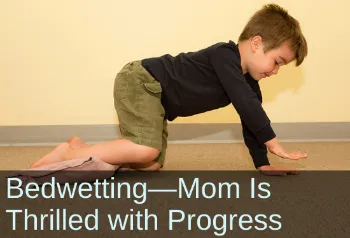
After integrating his Spinal Galant reflex and doing rhythmic movements, this little boy went from wetting the bed every other day to only once per week—with some weeks completely dry! Read the full case study.

This woman with PTSD had such severe bedwetting that she had to wear diapers and change them three times a night, every night. See how her therapist used rhythmic movements to help her become diaper-free in only 12 weeks!
References
Carter, T. L. (2020). An exploration of the relationship between unintegrated primitive reflexes and symptoms of anxiety in children between 10-13 years in the Western Cape Province of South Africa. [Doctoral dissertation. University of South Africa].
Forrest, D. S. (2002). Prevalence of retained primitive reflexes in patients with anxiety disorders. [Doctoral Dissertation, Annexe Thesis Digitisation Project 2017 Block 16.]
Hussong, J., Greiner, M., Schiedermaier, U., Mattheus, H., & von Gontard, A. (2022). Anxiety disorders, depression and incontinence in preschool children—A population‐based study. Neurourology and Urodynamics, 41(8), 1800-1808.
Warne, N., Heron, J., von Gontard, A., & Joinson, C. (2024). Mental health problems, stressful life events and new-onset urinary incontinence in primary school-age children: a prospective cohort study. European Child & Adolescent Psychiatry, 33(3), 871-879.

Sonia Story, M.S. has been teaching neurodevelopmental movements since 2006.
Sonia developed the Brain and Sensory Foundations curriculum and the Foundation for Optimal Function course to provide comprehensive training in neurodevelopmental movements—combining innate rhythmic movements, play, primitive reflexes, and postural reflexes.
She earned a Bachelor's degree in biology/psychology and a Master’s degree in Movement Sciences. She is the author of The Importance of Reflex Integration and the Evidence eBook, giving the rationale and evidence basis for using neurodevelopmental movements for helping with challenges such as ADHD, Sensory Processing Disorders, anxiety, emotional dysregulation, visual skill deficits, poor social skills, gross and fine motor delays and other neurodevelopmental and behavioral disorders.
Her work is featured in numerous podcasts, summits, and conferences, and in the books Almost Autism: Recovering Children from Sensory Processing Disorder; Special Ed Mom Survival Guide; Family Health Revolution; and Same Journey, Different Paths—Stories of Auditory Processing Disorder.
Sonia’s mission is to help children and families experience the profound benefits of neurodevelopmental and integrative movements for more functional and fulfilling lives.